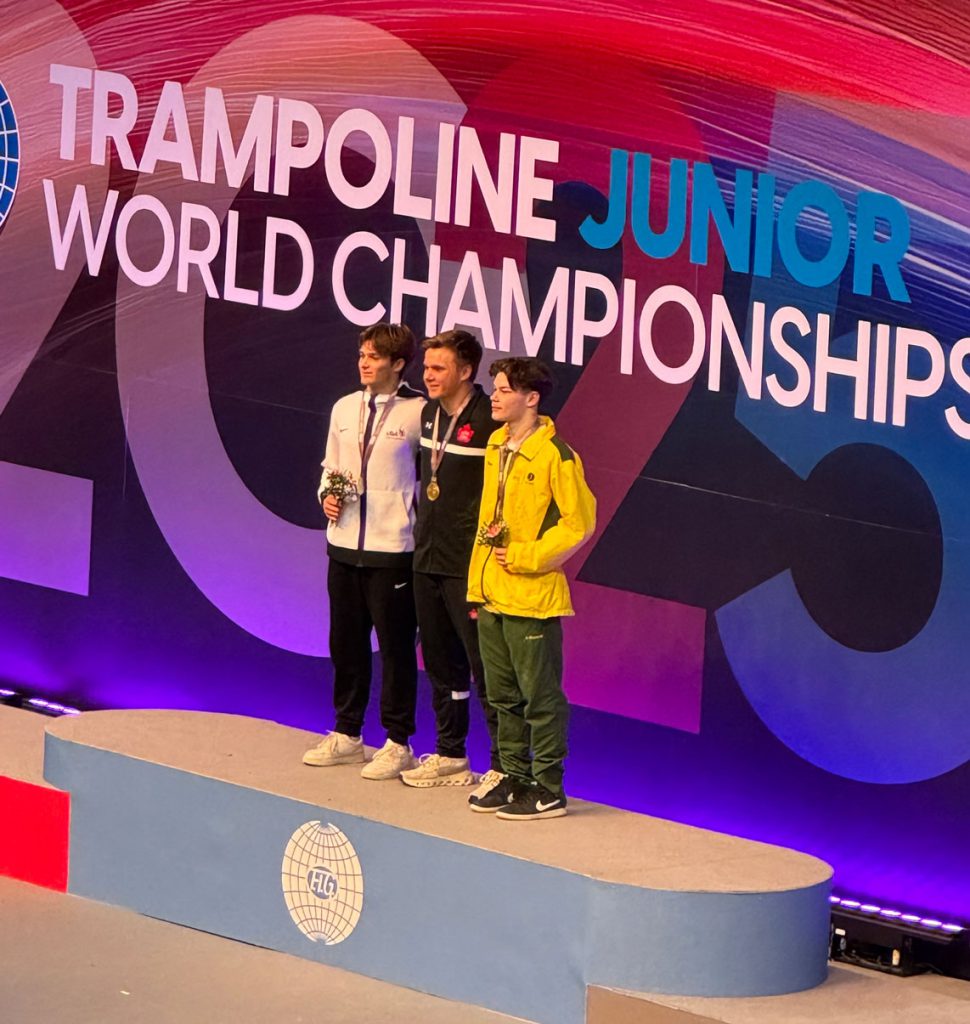

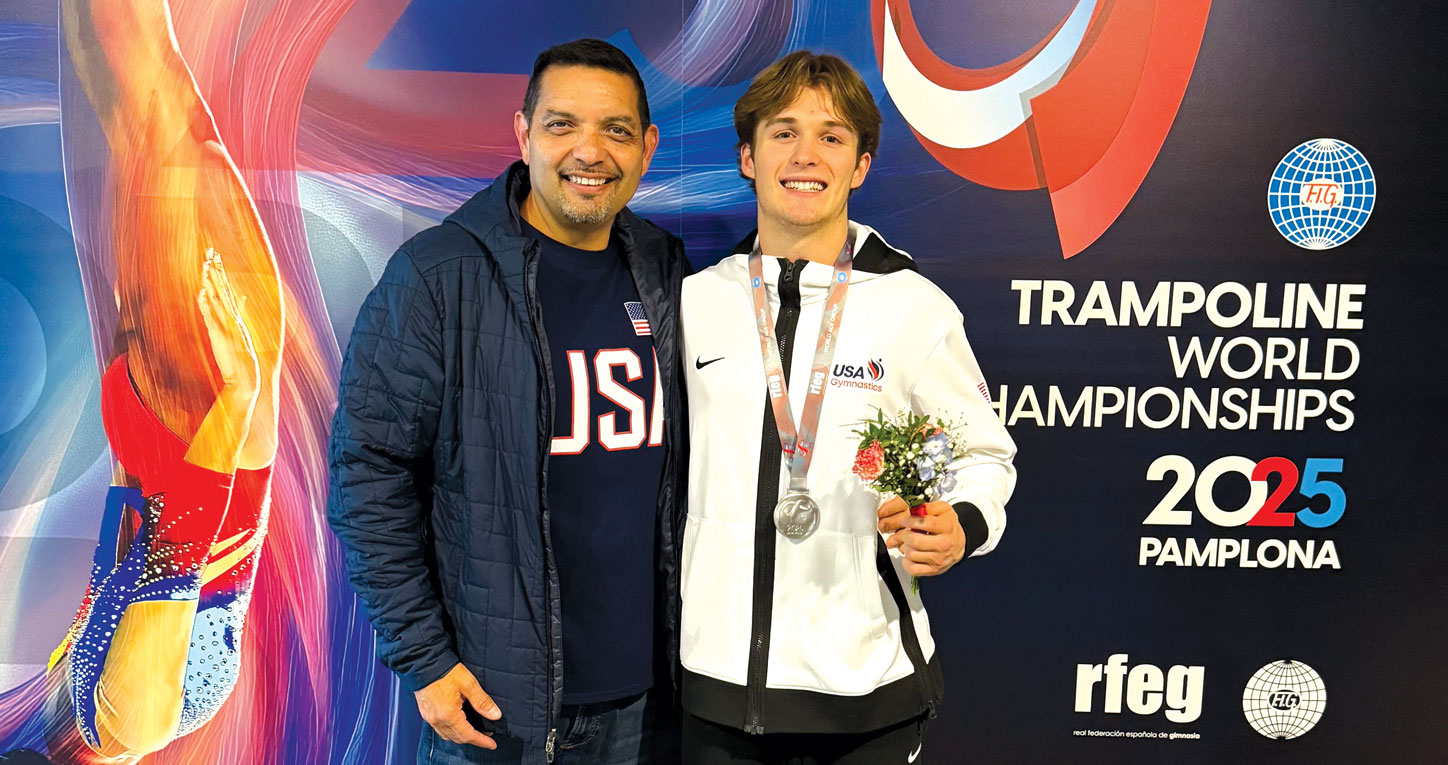
When Scotts Valley High School alum Nate Swanepoel clinched the silver for Team USA in double-mini-trampoline at the Fédération Internationale de Gymnastique World Age Group Competitions on Nov. 16, it represented a remarkable rebirth after a foot injury hobbled his airborne dreams three years ago.
In an interview with the Press Banner after practice last Monday in Phoenix, where he now attends Arizona State University and trains with North Valley Gymnastics, the 20-year-old explained why he loves the spring-based pursuit so much.
“Honestly, to me how I feel about it is, it’s really fun to put your body into those different positions in the air,” he said. “It feels like you’re flying.”
George Nissen and Larry Griswold invented the modern trampoline at the University of Iowa in 1934, and it was used to train astronauts, tumbling gymnasts, divers and others.
“People enjoyed the sensation so much, they began to trampoline for sheer fun, and it became popular in its own right,” notes a post on Olympics.com.
By 2023, according to research firm Market.US, the global trampoline park market alone was valued at $950 million and was projected to grow to more than $3.49 billion by 2033.
Swanepoel’s trampoline journey began when his parents entered him into a Brook Knoll Elementary School raffle and he won a free week at Vargas Academy of Gymnastic Arts.
“It was actually for parkour,” he said, of how he entered one discipline but soon shifted to another. “I saw the trampoline gymnasts jumping super high.”
His parents got a trampoline for the house, so he could practice the moves he learned during Vargas Academy classes at home.
“For me it was just so fun to jump around and learn a whole bunch of flips and tricks,” said Swanepoel, looking back to how he’d write down maneuvers shown to him by coach Vernon Vargas, then slowly work out the kinks. “He pushed me super hard.”
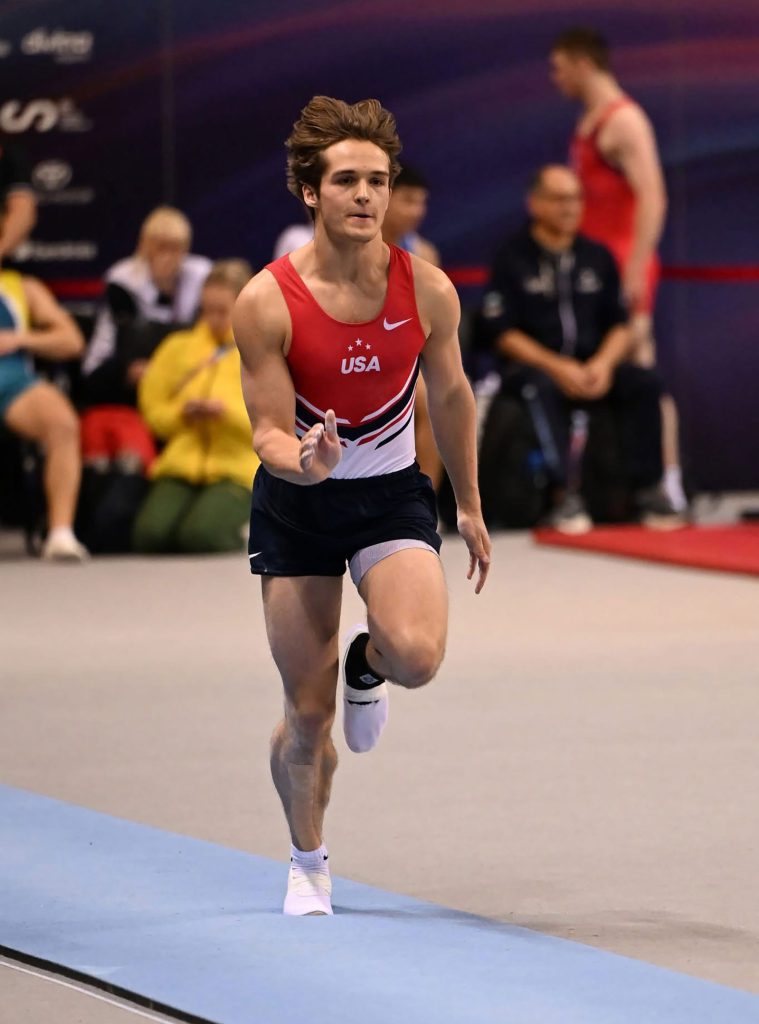
While there are three main paths in the sport he could have focused on, Swanepoel moved toward what’s called double-mini-trampoline, which sets the athlete down a linear path, then involves two air tricks—made possible by a long, angled trampoline—and a landing.
“It’s about 17-19 seconds from beginning to end,” said his mom, Kirsten Carraway.
Athletes get points for the difficulty of their tricks, the smoothness of execution and the quality of the landing: you’re supposed to land in the red rectangle, not the yellow one around that—or the blue area beyond.
“You get deductions if you land out of the red,” said his dad, Warren Swanepoel, the owner of W. S. Builders.
Injury Setback
By the time he was in his teenage years, Swanepoel was already facing off against other young trampolinists at national events. He said it’s not just the competitive aspect of the sport he likes, it’s also the camaraderie.
“There’s a huge community there. It just felt right,” he said. “I was like, ‘This is the place I want to be.’”
During his senior year at SVHS, Swanepoel got the opportunity to travel with Team USA for the first time to CAVU gym in New Jersey, to train for the World Age Group competition in Bulgaria.
“It was going really well,” he said.
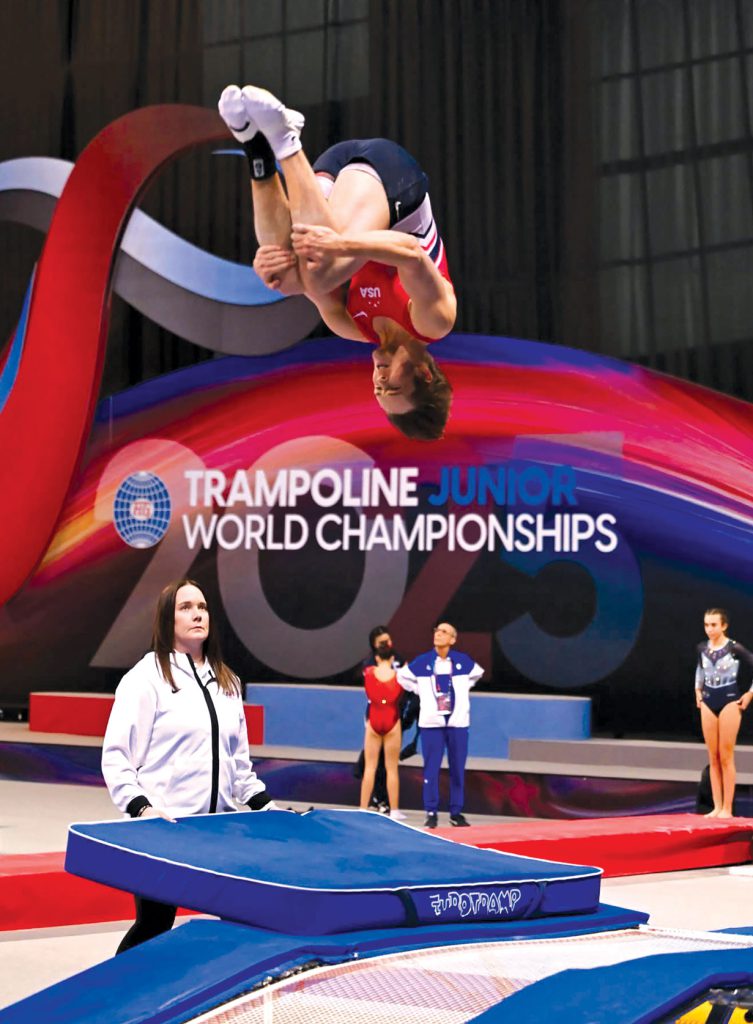
Then, on his final pass, he decided to push himself even harder than usual. The first trick, a triff-tuck (a triple-forward-flip with a 180-degree twist), went fine, but he messed up the second one—the triple-tuck (a triple backflip). He didn’t quite get the elevation he needed.
“I landed straight onto my ankle, spraining it,” he said. “I had to call the competition off and let someone else take my spot.”
“It was pretty devastating for him,” Carraway recalled. “He sprained his deltoid ligament in his ankle. That is super hard to do.”
So, when Swanepoel qualified for last month’s event in Spain—after years of ups-and-downs with physical therapy and training—she was so thrilled for her son.
“It was just pure joy to see him finally get his spot there, and get his moment to shine—and actually get to be rewarded,” she said.
Spain Success
Taj Gleitsman, 19, another longtime Vargas Academy student, also made it to the World Age Group Championships in Pamplona. Vargas flew across the Atlantic, too, to cheer on his former trainees.
Swanepoel’s parents got to see their son reach the second-place slot in the Saturday qualifying round. Unfortunately, due to last-minute contest-schedule changes, his parents were unable to attend the final day.
But on that Sunday morning, his triff-tuck, half-triff-tuck combo was a little shakier.
“But I still made it to my feet,” he said, about the run that allowed him to squeak through on tie-breaking rules.
He went last in the finals, and was in a pretty good position, as a couple opponents had fallen. But he didn’t want to use that as an excuse to let off the gas, either.
“I decided to do the pass that I performed first in the qualifying round: triff-pike to triple-back-tuck,” he said. “I don’t really think about the noises around me.”
He got the salute from the judges. Waved back. Down the runway. Solid trampoline connection. And did one of his best triff-pikes ever. Second trick: shakier. And the landing? One foot in the yellow, then momentum carried him into the blue.
He knew he’d be hit with deductions, but wasn’t sure how many. Now, his fate was in the hands of the judges.
“It’s a crazy feeling waiting for that score,” he said, recalling how the eyes of the crowd shifted to the jumbotron, where his result was about to appear. “Honestly, it’s cool because everyone in the arena is looking up.”
Then, his 25.100 score appeared on the board. He’d bested the Australian by .3 points. Canada’s Jeremy Meyer took the gold with 25.200—beating him by .100.
“All my teammates from Team USA were hoping that I got a good score,” he said. “Once that score flashed, it was just a crazy moment of everyone in the stands cheering for me.”
His parents got the news just as they were boarding their flight home.
“We were jumping up and down hugging each other,” said Carraway, who was looking forward to celebrating with her son over this past Thanksgiving weekend.