
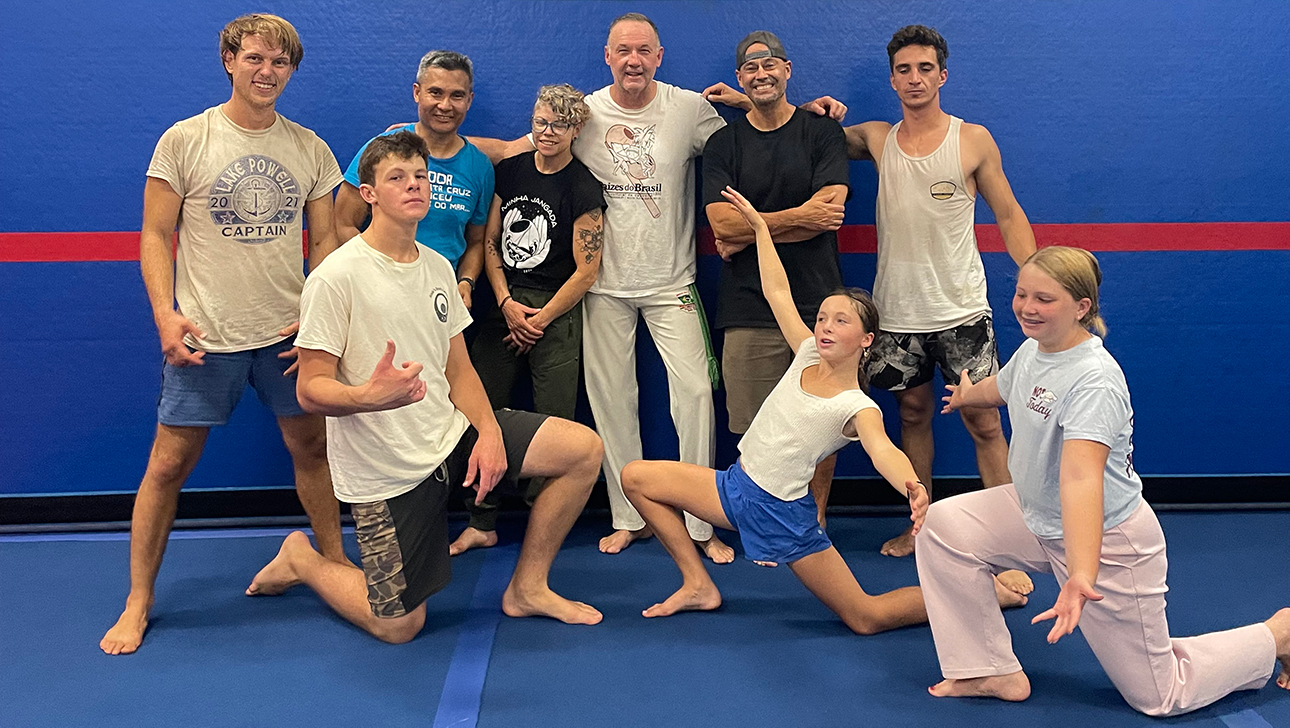
A few years ago, Felton resident Dale Knight was looking for an extra activity for his son, who had a lot of excess energy to burn.
After the second-grader found the Korean military school-derived discipline to be a little too rigid for his liking, his dad enrolled him in a capoeira class in the Harvey West neighborhood of Santa Cruz.
“This instructor was doing a move and it was like breakdancing,” Knight said. “My son immediately fell in love with it.”
This Afro-Brazilian martial art teacher even showed the dad how to do a cartwheel.
“I’d never had anybody show me that. I was like, ‘That’s neat!’” he said. “So, I signed up, and I started doing it with my son.”
His son is 18 now. And Knight has risen through the ranks to become an instructor himself.
Now, he’s been given the responsibility of managing Capoeira Santa Cruz’s foray into the San Lorenzo Valley.
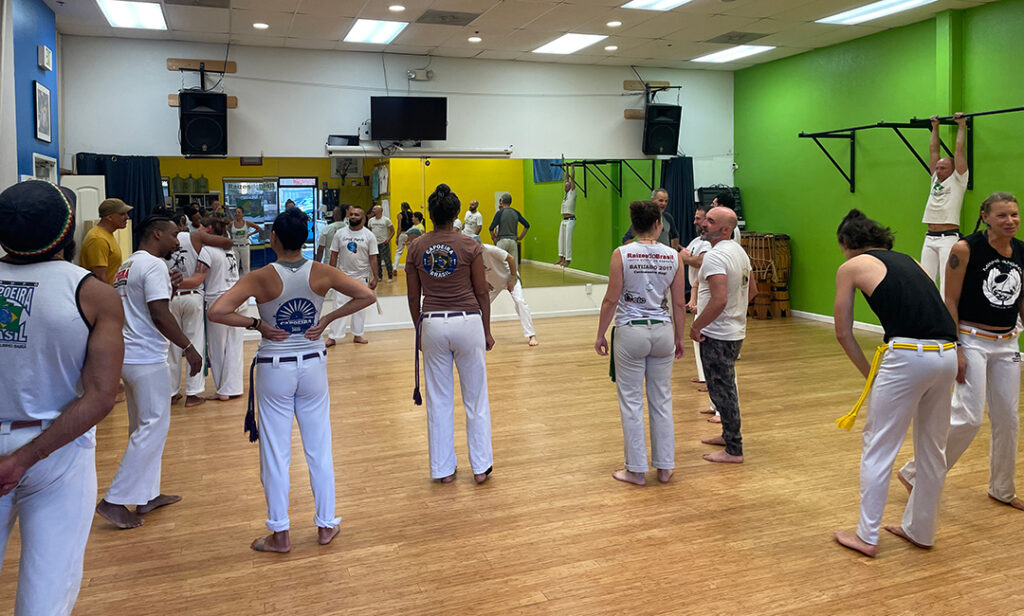
They’ve already begun hosting classes in a former video store location next to Verutti Liquor in Felton.
So far, it’s just one day a week: classes for kids around 5-12 at 5-6pm on Fridays, followed by instruction for adults from 6-7:30pm. The first class is free—and the more the merrier.
“Right now, I’m paying out of pocket,” said Knight, thinking of his overhead costs. “I’m not trying to make any money.”
How can that be? How can you launch an expansion with such a focus on fun and fulfillment over profit?
Well, to understand why this middle-school-English-teacher-by-day might say these sorts of things, you have to learn more about what the energetic activity means to Knight.
“The community of capoeira is the biggest part,” he said, describing the sweat, the high-fives, the music telling you how to move. “It’s just like this massive community that’s worldwide.”
For example, in his interview with the Press Banner, Knight said he couldn’t wait for an important upcoming gathering, a batizado (baptism), put on by a capoeira club in San Francisco that will feature former world champions.
His voice drips with excitement as he recounts the lore of the high-intensity-movement system, from its slave origins, to Mestre Amén Santo advising—and performing in—’90s Hollywood movie “Only the Strong,” to Contramestre Aldo Di-Bahia, another carrying on traditions from Salvador, Brazil.
And, Knight said it has helped to strengthen the ties in his own family, especially given he was 38 when his son was born.
“I don’t want to be that ‘old dad,’” he said. “I want to be able to be around for him and my grandchildren.”
Now, his two daughters and his wife train, too.
“It worked so well for me,” he said. “It’s such a positive thing, and I just want to share that with people.”
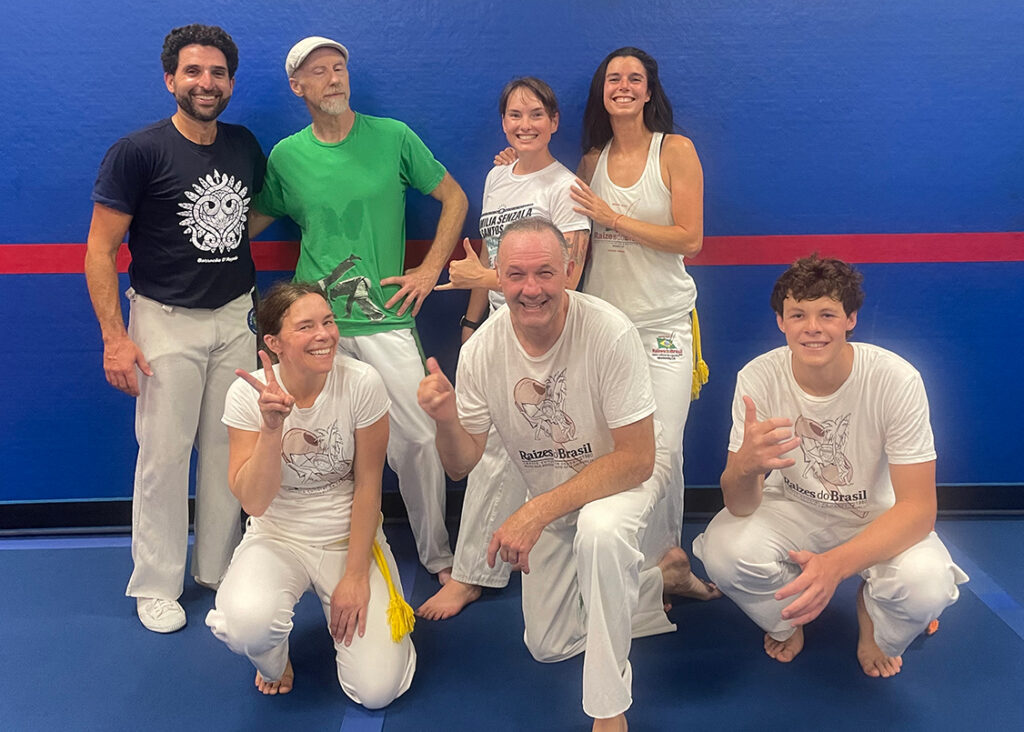
Instead of “belts” like in other martial art, capoeiristas are ranked by “cords” from “raw / white” (Aluno, or student) through “full blue” (Graduado, or graduated students), “full green” (Instructor), and “full purple” (Professor), all the way up to Mestre (the highest level, indicative of deep cultural mastery)—with several other levels in between. However, there’s no singular international governing body for the sport.
Knight made Instructor level (full green) last May. But he’s not letting that get to his head.
“I wasn’t necessarily looking to start a studio right away, but a space became available,” he said, recalling how he connected with Jessica Deshayes, the founder of Community Mountain Gym, and learned about her space along Highway 9 he now rents. “She wants to be a community movement place.”
Knight’s capoeira journey may have started with his son at that gym near Costco, but—after the building was sold—it soon moved to a nearby driveway. From there, he trained at the 418 Project, before studying on the Westside under Mestre Papiba, the founder of groove band SambaDá.
“It’s definitely a profound part of my life,” Knight said. “Now my path is—I’m wide open.”
What can newcomers to the dance-like martial art expect?
“We call it a conversation between two people,” he said. “We have takedowns. We have acrobatics. We have this complex art we share with each other.”