
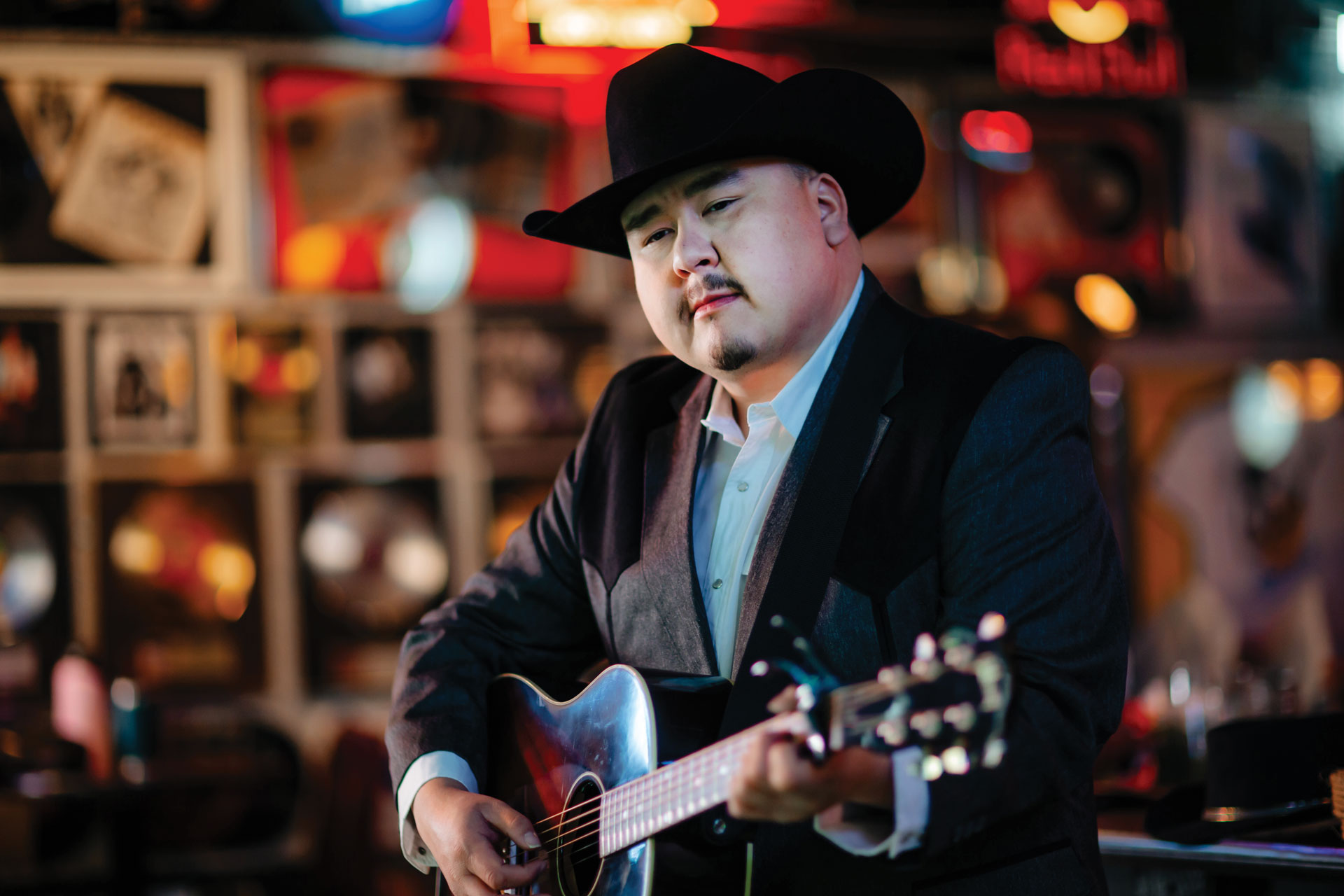
When American country singer-songwriter Vincent Neil Emerson arrives in the Santa Cruz Mountains on Jan. 23 to play the Felton Music Hall stop on his Red Horse Tour, he’ll arrive with special guest William Prince, who grew up—and still lives—in the central Canadian province of Manitoba.
Emerson has been releasing on La Honda Records for years (his latest album, “The Golden Crystal Kingdom,” is also on RCA Records and produced by Shooter Jennings), a record label that—while physically located in Bowling Green, Ky.—takes its inspiration from the little mountain town just a short jaunt north of here.
“La Honda Records is inspired by 1960s and ’70s classic design, rock ’n roll and honky tonk pioneers, and the raw, pure translation of freedom,” reads the label’s web bio. “Just like its namesake, La Honda, California, the label is a sanctuary for counter-culture and unheard voices.”
On top of figures like Hunter S. Thompson and Ken Kesey, one of the most famous faces associated with the La Honda vicinity is longtime ranch owner Neil Young (the son of Canadian journalist and novelist Scott Young), who spent several of his formative years in Winnipeg, where Prince now lives.
Prince, speaking over the phone from those snowy reaches, said it was an honor to get to open up for Young, seven years back.
“It was incredible,” he said. “I feel like it jumped me ahead a whole light year.”
Prince was born in Selkirk, Manitoba (a place I once traveled to, to play hockey. Since we’re both the same age, I couldn’t help but wonder if we played against each other in that tournament).
“I played hockey until I was about 12 or 13,” he said. “I was a winger for the first year, and then I was goalie—until I moved on.”
Eventually he moved to Peguis First Nation, where his ancestors served as hereditary chiefs. But his father and grandparents were preachers, and Prince performed in and around the reserve, as his creative side blossomed.
“I started to write poetry in junior high,” he said, recalling how he started on tambourine, then picked up piano and guitar. “Suddenly, I was dabbling in all the instruments.”
He had rock band dreams in high school. But he’s always been rooted in meaningful music.
“My first inspiration was Johnny Cash, and that’s not far off from gospel music,” he said, when asked about his October 2020 album “Gospel First Nation.” “I’ve always modeled my songs after great songwriters.”
Prince has come a long way from playing at Treaty Days at home, or the times he would drag his guitar around the big city of Winnipeg “and be brave.”
He’s opened for Willie Nelson as well as The War and Treaty, received The John Prine Songwriter Fellowship, and is now the owner of two JUNO awards.
He’s had his music featured on the show “Yellowstone,” and he’s just released his new album “Further From the Country.”
Many Canadian artists will go their entire career without even attempting to crack the American market.
Prince has already gotten to perform on influential stages like the Grand Ole Opry, at NPR’s Tiny Desk and on CBS Saturday Morning.
So, how does it feel to have made these kinds of inroads, south of the border? Well, like an underdog, it turns out.
“It’s like sitting at a poker table with a lot of other people that have a lot of chips, at the moment,” he said.
Meanwhile, things in his homeland are changing too.
Prince says he’s thrilled to see Manitoba is now being governed by Wabanakwut “Wab” Kinew, Canada’s first provincial premier of First Nations descent—whose family hails from a community nearby in Ontario (Ojibways of Onigaming First Nation).
“I’m glad the government that’s there is in place,” he said of Kinew, who was found to be Canada’s most popular premier in a recent Angus Reid Institute poll. “To me, this feels like one of the bigger acts of reconciliation.”