


For Scotts Valley City Council all to be in sync, it took a quick hand-off of a mystery item by Kirsten Maure to her husband, Greg Wimp, the body’s newest member, as the Dec. 17 meeting began.
It was a bag containing a Christmas sweater, which Wimp promptly passed along to outgoing mayor Derek Timm, so everyone on the dais would be appropriately garbed in holiday attire.
Almost as soon as he’d done so, he sheepishly recused himself, as the consequential public hearing on the Town Center came up—because his sandwich shop is located in the vicinity of where the massive mixed-use development is slated to rise.
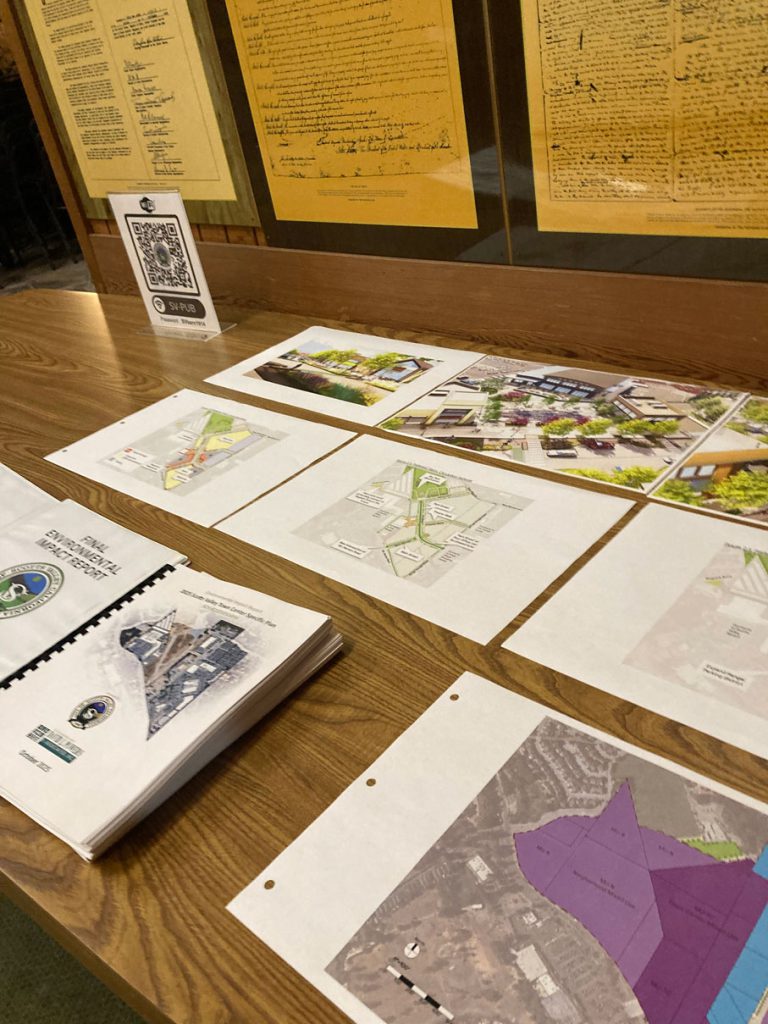
Troy Reinhalter of consultant Good City Company explained how the environmental impact report (EIR) and specific plan for the Town Center development updates the original 2008 project, which was created in an era when the housing crisis was taken less seriously by the state and the retail landscape was completely different.
“The vision is for a gathering space with active retail frontages, public plazas, vibrant streets,” said Reinhalter, adding their creation will be “an active mixed-use destination that is a draw for local residents.”
By any measure, this represents a huge step forward for the community: 657 units of housing (last time it was 300), to try to catch up on all the years where Scotts Valley underperformed in producing its fair share of residential units; 35,000 square feet of public space (unchanged from the prior document); and just 82,000 square feet of commercial (down from 275,000 square feet from the initial project).
Not everyone loves the plan.
Back on Nov. 19, community member Juliana Maggio wrote to the City to raise her concerns.
“The proposed plan for the town center appears to have an excessive amount of house units and we are concerned about the traffic that this will create in such a small area,” she said in an email. “We envision more restaurants, cafes and shops where we can buy clothes, and shoes and gives (the) town a more cohesive look and feel.”
Trent Cates, who lives with his family near the middle school, also emailed to say he’s worried about the potential loss of the community’s “unique small town feeling,” if the Town Center plan moves forward.
“It will be the beginning of a process that robs us residents of everything that (makes) Scotts Valley unique and the most desirable area to raise a family in,” he said. “This will not end well for the community of Scotts Valley. The only individuals that will truly benefit from this project moving forward are the developers/realtors, and the politicians that get to pat themselves on the back for ‘achievements’ that look great on paper but are a slow poison for the once thriving close-knit community.”
However, Sonja Trauss, executive director of YIMBY Law, says Scotts Valley still isn’t going far enough to ensure the housing they’ve promised the Department of Housing and Community Development will actually get built.
“The Housing Element’s Programs committed to zoned capacity that the program does not meet, which threatens the continued certification and compliance with state law,” she wrote Dec. 4, pointing to a recent California Court of Appeal decision (New Commune DTLA LLC v. City of Redondo Beach) that appears to have just upped the stakes for municipalities when it comes to facilitating housing, once again. “The current zoning plan does not comply with the Scotts Valley Housing Element or California rezoning requirements. Without going through this process, Scotts Valley cannot ignore or abandon the programs it committed to in its adopted housing element. Failure to comply with Housing Element law exposes the City to significant legal risk.”
Santa Cruz YIMBY says Scotts Valley isn’t going far enough to promote the development of as many as 963 units it told the state it could potentially create in the Town Center area (if built out at fully-zoned capacity, and factoring recent statutory changes into the calculation).
On the other hand, Affordable Housing NOW! said it “enthusiastically supports the Certification of the EIR Report,” adding that around 90% of employees in Scotts Valley don’t live within its boundaries.
“The commercial elements of a Town Center will increase that number,” wrote Tim Willoughby, the chair of AHN, on Dec. 12.
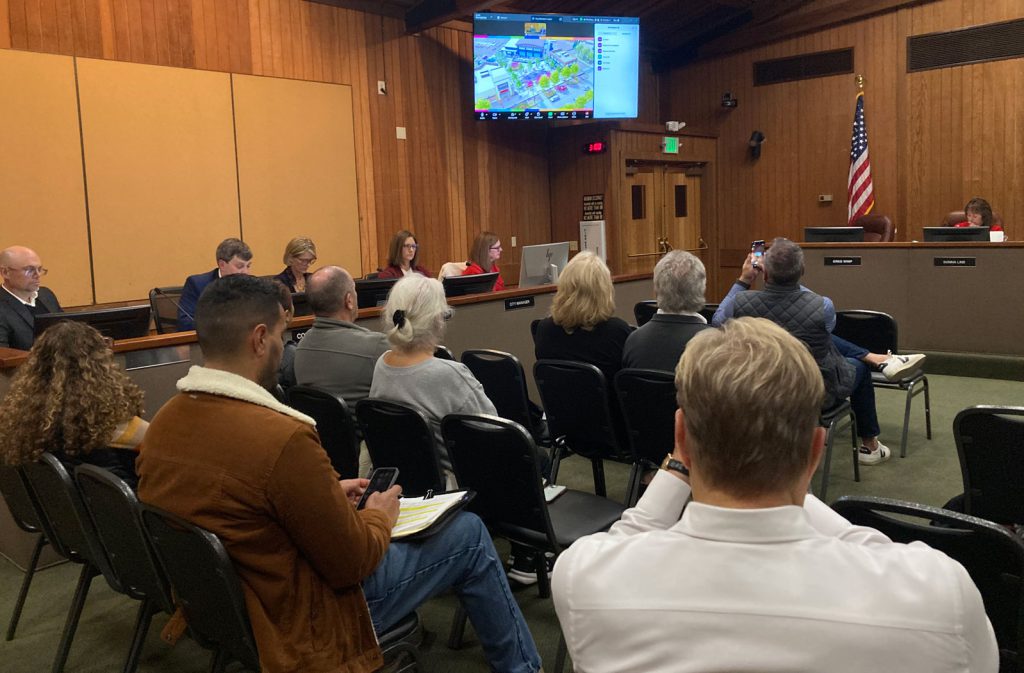
While many of the fears of concerned residents may turn out to be overblown, Council heard at the meeting that in at least one area, there is now hard data to back up the fact that things are about to get worse—at least by a little bit.
And that area is traffic. The “Level of Service” is set to drop by a full letter grade (on a scale that goes from A to F)—essentially a slowdown of 10 to 15 seconds during afternoon rush hour at a single intersection.
The City’s consultant said, overall, residents will only see a 5-20% worsening of traffic patterns, depending—in part—on whether Council approves a new traffic light and other road improvements.
Realtor Robert Aldana, who was watching from the audience, shook his head at this information; however, when he got up to speak during public comment, he didn’t mention anything about the issue—focusing instead on urging Council to include a splash pad and other family-friendly amenities in the final designs.
Councilmember Steve Clark emphasized that—the way he sees it—there’s only a minor reduction in service that can be at least partially mitigated, at just one intersection, and only during the evening rush hour (not even the morning traffic jam).
And anyhow, the state no longer looks at Level of Service to decide whether a project is up to environmental snuff. These days it considers Vehicle Miles Traveled. And in this case, there could be some reductions in this area (if fewer residents have to drive up from Los Gatos, Santa Cruz or Watsonville, because they can move into an apartment in town).
In the end, both the Town Center Specific Plan and its EIR were approved unanimously.
At the end of the meeting, Vice Mayor Donna Lind was named mayor and Clark became the new vice mayor.