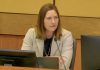


When Monica Martinez reflects on her first year as Santa Cruz County’s Fifth District supervisor, one word comes up again and again: whirlwind.
“It’s been busy,” Martinez said. “But I’m really proud of what we’ve been able to accomplish.”
That sense of urgency has defined Martinez’s first year in office. Sworn in just as shifting federal policies began rippling down to local governments, Martinez found herself navigating high-stakes decisions almost immediately, often with the county’s most-vulnerable residents at the center of the conversation.
Within her first month on the Board of Supervisors, Martinez brought forward a resolution to protect women’s autonomy and the LGBTQ+ community amid early policy changes from the Trump administration. That resolution didn’t stop at symbolic language—it came with funding, too.
“We were able to dedicate resources to immigrant-supporting organizations and LGBTQ+ groups,” Martinez said. “We knew they were going to be doing a lot more work and facing a lot more pressure.”
That approach of pairing values with tangible action has become a hallmark of her leadership.
When a federal government shutdown threatened SNAP benefits, Martinez helped push through up to $500,000 in emergency funding for the local food bank. In the end, only half the funds were needed when the government reopened, but the speed of the county’s response drew attention statewide.
“When I shared what we’d done with other county supervisors, they were shocked at how quickly Santa Cruz County moved,” Martinez said. “That comes down to strong partnerships with community-based organizations. We know each other, and we trust each other.”
In the San Lorenzo Valley, Martinez has taken a hands-on approach to strengthening food access. She convened food-providing organizations across the Fifth District, including groups like Second Harvest, Valley Churches United and local food pantries, to improve coordination and communication. The result was a simple but powerful one-page guide outlining where and when food distribution happens throughout the valley. It’s been shared widely and continues to evolve as needs change.
“That kind of collaboration matters,” Martinez said. “Especially when people are already stretched thin.”
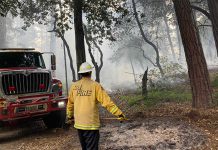
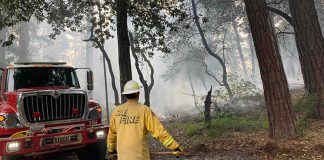
Wildfire preparedness is another area where Martinez’s impact has been felt almost immediately.
During one of her first office hours, members of a local Fire Safe Council raised a concern: green waste removal, a critical step in home hardening, is expensive and often out of reach for residents already doing hours of volunteer labor to clear defensible space.
Martinez took the question to Public Works. The result was a pilot program offering free green waste disposal every Saturday in August 2025.
“Hundreds of people took advantage of it,” she said. “And now my colleagues are asking how to bring it to their districts.”
The success has already sparked plans for a countywide program launching this spring.
“It’s people doing the work,” Martinez said. “Clearing their properties for fire safety. The least we can do is remove barriers.”
Accessibility and communication have been central to Martinez’s first year. She holds office hours every two weeks, rotating locations and times across the district from Felton and Ben Lomond to Boulder Creek and Scotts Valley. In just one year, she’s met with more than 125 residents one-on-one.
“I’ve never had an office hour where I was waiting for people to show up,” she said. “There’s always more demand than time.”
She’s also hosted multiple town halls, including evacuation-focused meetings in Zayante and Lompico—communities with limited escape routes and a rapidly changing population.
“When I asked how many people had lived here during the CZU Fire, only about half raised their hands,” Martinez said. “That tells you everything about why communication and preparedness are so critical.”
Winter storms and prolonged power outages have tested the county’s emergency response systems, and Martinez’s leadership, over the past year. She doesn’t shy away from acknowledging the frustration residents felt following days-long outages in the San Lorenzo Valley.
“I spent Christmas morning with my kids in the dark and the cold,” she said. “I get it.”
While PG&E controls power restoration, Martinez has focused on what the county can do: advocating for warming and charging centers, strengthening partnerships with libraries, gathering resident feedback and pressing utilities and state regulators for better infrastructure support.
“The community is changing,” she said. “People rely more on electricity now—for medical devices, heating, transportation. Our systems have to evolve to meet that reality.”
Her office is now pushing for clearer criteria to trigger warming centers during winter outages and advocating for PG&E-supported generators at public facilities—regardless of whether an outage is caused by storms or public safety shutoffs.
When asked about deploying those centers during a recent round of storms that impacted most SLV families for five-plus days, Martinez said the need wasn’t there at that time: “There wasn’t the severity of power outages during those storms.”
As Martinez prepares to step into her new role as chair of the Board of Supervisors, she’s under no illusion about what lies ahead. Budget pressures, healthcare access and the stability of the county’s safety net loom large, especially as Medi-Cal changes take effect in 2026.
“These are our residents,” she said. “Even when services aren’t reimbursed, the needs don’t disappear.”
Healthcare, immigrant protections, emergency preparedness and public trust remain at the top of her agenda. Some initiatives, she said with a smile, are still under wraps.
“I have a few things I’m not ready to talk about yet. This job is about listening,” she said, “and then doing everything you can to turn what you hear into action.”
To contact Martinez or to arrange a visit during her office hours, visit santacruzcountyca.gov/government/boardofsupervisors/district5.aspx.