





State assembly primary race

Vicki Nohrden, evangelical director of the nonprofit Wind and Fire Ministries in Carmel, is challenging three-term incumbent Mark Stone (D-Monterey Bay) for the 29th State Assembly District seat in Sacramento in the June 5th primary.
Falcon lacrosse cleans up Aptos for title

The Scotts Valley lacrosse team made quick work of their hosts, the Aptos Mariners, winning 14-2 on May 6, at Trevor Dilfer field in Aptos. The victory gave the Falcons the Santa Cruz Coast Athletic league title outright and ensured their placement in the Central Coast Section playoffs.
Organizers put finishing touches on Marvelously Magical Night Market spectacle

Soquel resident Will Barba, 26, says the idea for the upcoming gathering he’s planning with his business partner, 25-year-old Tristan Piotrowski, was sparked by time spent overseas.
“Truly the inspiration for this comes from my travels in Türkiye,” he said, looking out past flag bunting...
Gardener: The gardens of southern Mexico: Part 2.

What would you plant if you lived in a flat area with very poor drainage? Where the landscape is shaped by limestone or dolomite bedrock, and the shallow soil is filled with carbonate rock? Where there is limited surface water and no above-ground rivers, and where lakes and swamps are present, but the water is marshy and not palatable for drinking? Where you have two seasons, six months of rain and six months dry, and — oh yeah — did I mention you get 100 inches of rain during the wet season?
The Dammed River: Mr. Pierce’s Neighborhood
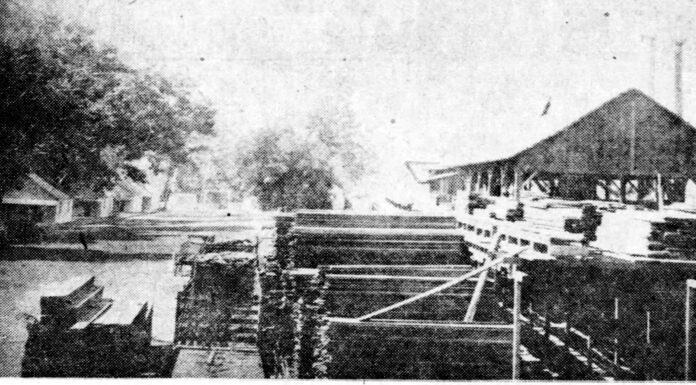
1887. From the porch of “Hillside,” his aptly-named summer estate, timber baron James P. Pierce could literally oversee his domain. Away to the north were redwood-covered slopes, awaiting harvest. In the foreground, just across the San Lorenzo River, was the site of his new Pacific Mill, a railroad station, and what one visitor referred to as “quite a little village.”Pierce had made a fortune washing gold off hillsides with powerful hoses. After investing in the San Lorenzo flume and railroad in the 1870s, he purchased 2000 acres of uncut timberland in the heart of the valley. The original Pacific Mill at the mouth of Love Creek worked up lumber along the river to what is now Glen Arbor, relying on the flume for transportation. When the Felton and Pescadero railroad was completed in 1885, Pierce quickly recognized a different opportunity for profit and relocated his operation across the river.The new Pacific Mill was thoroughly up-to-date, containing machinery for the manufacture of all sorts of finished lumber. In addition to the usual circular saws, it housed a band saw, the first in the area, allowing finer processing. “Every part of the log is worked up and nothing wasted,” the Pacific Rural Press reported in 1887, “Even all the spare sawdust is sold to a San Jose brewery at $25 a carload. More could be sold there, but it is used at the mill to fire the boilers.”The water of San Lorenzo was also utilized, brought into a large mill pond on the low ground where the river looped around the site. “A dam is being built, noted a reporter, “and a pond constructed where the logs will be floated for more convenient selection before sawing. A railway is in process of construction…on both sides of the pond, where the logs will be unloaded directly into the water.” Although there had been sawmills in the area since pioneer days, much of the old-growth forest on the difficult local slopes had survived. Pierce’s lumber-cutting campaign relied on transportation. The railroad depot became a hub that linked the new bridges to the surrounding region and the spur tracks that led to the sawmill. In cooperation with the Ben Lomond Wine Company, located on Empire Grade, what is now called Alba Road was cleared and graded, providing access to the trees on the side of Ben Lomond Mountain. On the other side of the river, the timber in the upper reaches of Love Creek would be taken out by his company’s own train, running three miles up its corporate track. To support the mill and its workforce, Pierce and his superintendant, Thomas L. Bell, provided a variety of other buildings on the river bank across from the mill — a general store, warehouses for grain and hay, a boarding house for the men, cottages for families and a large amount of stabling. “The finest of water” was brought in from Marshall’s creek, through over 1500 feet of pipe.More than the usual amenities were provided. The company store offered both telegraph and telephone service and a Wells Fargo Express office. “The Post Office, “observed the Santa Cruz Surf, “will doubtless be established in the same place.” This prediction proved true in April 1887. Federal authorities, however, rejected the name “Pacific Mills,” so the appellation “Ben Lomond” was borrowed from the nearby mountain and winery.While train and mill whistles signaled a rush of industrial activity, Pierce planned a different sort of future for Ben Lomond as a place “of residence and resort.” His ideas were up-scale — this was not to be a “stump town” like Boulder Creek. His own residence, “Hillside,” which featured a large reception room and a “baronial” fireplace, was designed to convince other affluent businessmen to move to the neighborhood.In the fall of 1887, the land around the mill and railroad depot was subdivided into town lots. The Sentinel approved, noting that “Mr. Pierce, by these sales, is proving himself a benefactor to the neighborhood – new people are moving to that locality, houses are being erected, homes established, grounds cultivated, orchards set out and a population of sterling, thrifty citizens secured.”To further the goal of attracting high-class summer visitors, Pierce and Bell planned a luxurious resort. “One of the prettiest locations in the village,” advertised the Surf, “has been reserved for a hotel site. It is a roomy, wooded knoll, sloping downward to the San Lorenzo on one side, quite convenient to its railroad station and commanding picturesque mountain and valley views.” The site would also feature “an abundance of water.”(To Be Continued)Randall C. Brown is a local historian and is a member of the San Lorenzo Valley Board of Directors
Native habitat restoration in San Lorenzo Valley
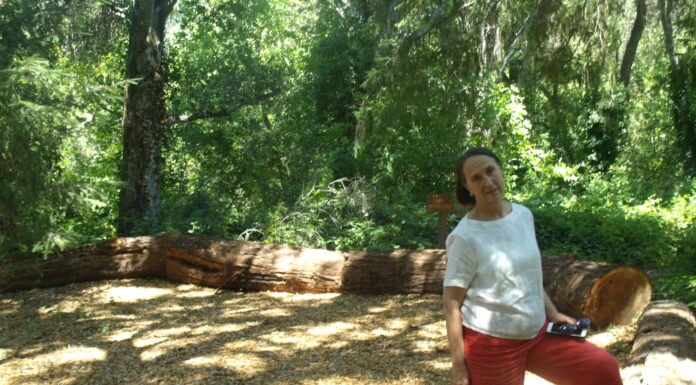
Linda Skeff is on a mission- to eradicate invasive species and restore native plant habitat up and down the San Lorenzo Valley. After three years of leading teams of AmeriCorps Volunteers to “pull out the invasive and restore the natives”, Skeff has her sights on a nearer term goal than the whole valley, but no less ambitious.
The Mountain Gardener: Rose expert shares secrets

Surrounded by roses of nearly every color in the rainbow, I smelled vanilla, spice and honey. The sun peaked in and out of the clouds allowing the vivid hues of the petals to change with the light. I was enjoying the garden of rose aficionados Mark and Lane Maloney of Scotts Valley. Among their 40 rose bushes I was to learn how an expert cares for these beauties.
Boulder Creek gains federal Opportunity Zone status
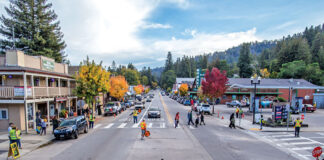
Boulder Creek has received a federal Opportunity Zone designation, opening new opportunities to attract private investment, support local businesses and strengthen the community’s long-term...