
New Laws in 2020
Each year, the great State of California institutes a buffet of new laws to (theoretically) improve our quality of life, our safety, and enhance our rights. While some recently passed laws are routinely ignored (hello, headlights-on-when-windshield-wipers-are-on), the general idea is, “As California goes, so goes the rest of the nation.” Keep reading, and you’ll note two different markers on the bill titles. AB means Assembly Bill; SB stands for Senate Bill. The designation helps consumers better understand where the new laws are generated, and can better illustrate which set of lawmakers is responsible for their creation and passage. Following is a list of the new state laws that will take effect on January 1, 2020. (Data provided by ABC7.com.) PRIVACY AB 375: Online privacyWant to know what information companies like Facebook or Google are collecting about you? The California Consumer Privacy Act (CCPA) gives internet users more control over their data. Among other things, the law gives users the right to know what data is collected, the right to reject the sale of your information and the right to delete your data. (See addendum article for particulars on this very important law.) WORKPLACE SB 3: Minimum wageAnother pay hike is on the way for minimum wage workers. The minimum wage in California goes up by one dollar to $12 an hour for workers at companies with 25 or fewer employees and to $13 an hour for workers at larger companies. AB 5: Independent workersWhile aimed directly at gig workers (think Uber, Lyft and DoorDash), this new law may also apply to many more contract or independent worker in California. Under AB-5, workers would be considered employees, and are entitled to minimum wage, workers‘ compensation, and other benefits. (29th District Assemblymember Mark Stone was a co-sponsor of this bill.) SB 188: HairstylesCalifornia becomes the first state to ban workplace and school discrimination based on a person's natural hairstyle or hair texture. Protected hairstyles include braids, twists and locks. Remember the high school wrestler in New Jersey who was forced by the match referee to cut off his dreadlocks? California says, “Not in this state, you don’t.” SB 142: Lactation accommodationsWhile California has had a law requiring employers to provide breaks for nursing mothers, many were forced to express breast milk in a bathroom stall or office closet. This new law requires companies to provide appropriate lactation accommodations that is close to the employee's work area, has electrical plugs and is free of intrusion. All working mothers, say it with me: It’s about damned time. AB 51: Arbitration agreementsStarting January 1, workers can't be forced into mandatory arbitration by an employer. The law bans mandatory arbitration agreements with employees. The law does not apply to arbitration agreements entered into prior to January 1, 2020. SB 1343: Sexual harassmentRequires businesses with at least five employees to provide sexual harassment training to its employees within six months of being hired, and every two years after that. (Is anyone else surprised that this is JUST NOW a thing?) SB 83: Paid family leaveNew parents will have more time to care for their child. Benefits under Paid Family Leave will increase from six weeks to eight weeks starting on July 1, 2020. HOUSING AB 1482: Rent controlCommunities without their own rent control laws will now be covered by statewide rent control protections. The law limits rent increases to 5 percent each year plus inflation, but never above 10 percent total. The law does not apply to housing built in the 15 years prior. The limit is a rolling number so the date housing is excluded changes every year. AB 652: Religious displaysYou have more protections to display religious items like menorahs or crosses outside your home. The law prohibits landlords and homeowner associations from banning the display of religious items on entry doors or door frames. The items cannot be larger than 26 by 12 inches. SB 222: Housing discriminationThis law expands existing law to protect veterans and military personnel against housing discrimination. MARRIAGE SB 30: Domestic partnersWhat's good for same-sex couples is good for heterosexual couples. This law allows heterosexual couples to register as domestic partners instead of getting married. Currently, only heterosexual couples age 62 or older were allowed to register as domestic partners because of social security benefits. The new law could help couples with combined higher incomes avoid the federal marriage tax penalty. EDUCATION SB 419: School suspensionsStudents in elementary school can't be so easily suspended for causing trouble at school. The law bans schools from suspending students in grades 4-8 for disrupting school activities or defying teachers and administrators. Students in grades K-3 already have this protection. High school students must wait until 2025 for the same benefit. HEALTHCARE SB 104: Healthcare for undocumented immigrantsCalifornia becomes the first state in the nation to offer government-subsidized health benefits to young adults living in the country illegally. The law expands the Medicaid program to include low-income adults age 25 or younger regardless of their immigration status. AB 2119: Transgender youthTransgender youth in the foster care system will get appropriate health care. The law is the first in the country to include access to gender-affirming medical services, mental health counseling, hormone therapy and surgery. CRIMINAL JUSTICE SB 439: Juvenile hallThis law changes the age that a minor can be sent to juvenile hall. Minors under 12 who commit non-violent crimes would be released to his or her parent or legal guardian instead of being sent to juvenile hall. The law does not apply to minors who commit murder, rape, or great bodily harm. SB 970: Human traffickingOperators of motels and hotels in California must provide training to teach its staff how to identify victims of human trafficking. ANIMALS SB 1249: Animal testingProhibits the sale of cosmetic products with ingredients that were tested on animals after January 1, 2020. The law does not affect products sold globally where animal testing is required by law. AB 1762: Dog areasThe California Department of Parks and Recreation has until July 1, 2020 to establish a comprehensive list of state parks that allow dogs, including the specific areas that allow dogs and the total miles of trails that are open to dogs. WILDFIRES SB 167: Public safety power shutoffsRequires utilities like PG&E to devise plans on reducing the negative impact of planned power shutoffs to first responders and people with disabilities. AB 247: Tree trimmingGives the California Public Utilities Commission more oversight over tree trimming efforts by utilities. Power companies would have to submit timely reports on their brush and tree trimming work. San Lorenzo Valley residents may have helped to drive this legislation forward based on their responses to the 2019 spate of tree trimming. SB 209: Wildfire warning centerEstablishes a wildfire warning center to broaden the state's ability to predict and prepare for wildfire. The center would rely on a statewide network of automated weather stations and fire detection cameras. Want additional information on these new laws? Visit www.leginfo.legislature.ca.gov
Holiday Lore & Traditions
We all celebrate the holidays in different ways. Each family has their own traditions and warm memories from years gone by. Some of us celebrate Christmas, some Hanukkah, some Kwanzaa. Many of our traditional Christmas customs originate from winter solstice celebrations. The plants associated with each are an important part of tradition and symbolism.
NEVER stop clowning around!
The concept of a “clown conservatory” is a bit difficult to wrap your head around. Are they conserving clowns, or teaching clowns to conserve? Are the clowns being taught the finer points of “Reduce, Reuse, Recycle?” And really, can you teach a person who’s wearing a multi-colored wig, face paint, a red nose that honks, ill-fitting pants held up by suspenders and big, floppy shoes to be “conservative?”If anyone can, it’s Jeff Raz who has been doing so since 2000, the year the Clown Conservatory was founded in San Francisco, California.Raz has an impressive track record as a clown. From his humble beginnings as a street juggler in the 70’s, he has gone on to become a virtual “who’s who” in the world of clowns. He’s juggled with the Bay City Reds, one of the most successful juggling troupes in the country. In the 80’s, he spent most of the decade with Vaudeville Nouveau, including a Broadway production of Comedy of Errors. He emerged in the 90’s as a writer, where he wrote and performed plays while performing with the Pickle Family Circus and acting in theaters around California. Raz led the Clown Conservatory at S.F. Circus Center from 2000 until 2010. During that time, he participated in a 500-performance tour with Cirque du Soleil’s Corteo, in English and Japanese, while still running the school.And now, Jeff Raz is bringing his irresistible clownish self to downtown Santa Cruz on December 14th to participate in Tandy Beal’s next installation of her ArtSmart Family Concert Series at the Veterans Memorial Building.Is there an art to being a clown?“Of course there is,” says Raz. “One colleague said, ‘I don’t teach the clowns, I walk beside them.’ We teach hard skills: our clowns learn to juggle, ride a unicycle, perform acrobatics and mime, and a lot of circus skills in a wide range.” Raz is hurriedly ticking off every element of Clowning 101. “There’s the history, current practices, clowning of other countries, makeup application—there’s lots to learn.” It must take a certain type of person to want to try being a clown, I muse. Raz is emphatic: “I trust that every student that comes to my school is a little weird, and that they’ve got what it takes to be a clown. My job isn’t to excavate that; my job is to give them the forms to let that come out.”“Is it really that daunting?” I ask. Raz nods. “Being a clown is quite hard but very rewarding. It takes a lot of practice, and things can be tough. The upside is you get to work with lovely people in very electric, creative settings. Clowns are able to connect with the audience in a deeper and more evocative way than any other performer. The main skill is to take 2,700 people and make them feel like they’re in your living room. In the business, it’s called Shrinking the Theater or Shrinking the Tent. How deeply and skillfully do the clowns make a connection with the audience? That’s the litmus test for success,” says Raz.For the upcoming performance in Santa Cruz, what should the audience expect? “There’s this assumption that clowns are for kids,” Raz says. “Clowns were adult entertainment for the last 50-70 years, but I always welcome anyone who wants to volunteer. You know what’s funny,” says Raz, “is the kids on stage are having a level of success on that stage that they don’t normally have in the classroom. I always try to pick a kid from the back of the room. It provides a moment for the volunteers to find comfort and their voice on stage,” he says.After performing for 47 years, Raz finds that he has to keep giving himself new challenges. “My challenge for the last few years is how to be radically present,” says Raz. “I don’t always succeed, but I want to be right there with that audience, with that volunteer, and completely respect that we have a reciprocal relationship. My interest,” says Raz, “is to invite someone to be more themselves than they were a moment ago, and sit back down a hero.”“Is there an example of that?” I ask. There is, Raz tells me, and it happened right here in Santa Cruz. “When I was a member of the Pickle Family Circus, we came to do a show with Tandy. Lo and behold, we got a volunteer who had just had hip replacement surgery, and he wanted to participate in the show. We got this amazing guy to come up on stage and stand on my shoulders with a new hip! The whole audience was cheering like crazy for him. When I came into the lobby after the show, he was in the lobby signing autographs.”Raz has had plenty of time in the spotlight himself. As the lead clown in Cirque du Soleil’s Corteo, he did ten shows per week, filling 3,200 seats per performance in Japan for 14 months.And now? Raz has written two times on his favorite subject: being a clown. The Secret Life of Clowns and The Snow Clown are authoritative works by an author whose specialty is making the world a lighter, brighter and less conservative place.Interested in learning more? Visit https://secretlifeofclowns.com and be sure to attend his upcoming performance in Santa Cruz. Tickets for Tandy Beal’s ArtSmart Family Concert Series are available at www.brownpapertickets.com
Homelessness and Syringe Use in Santa Cruz County
These past couple of months have ignited quite the discussion throughout Santa Cruz County. Between colder weather, the spontaneous reopening and closing of Ross Camp, the Harm Reduction Coalition’s proposals for new syringe exchanges, and the Santa Cruz County Syringe Services listening sessions, most dinner tables in our community are abuzz with this difficult topic. How can we best help, while limiting, the homeless population, syringe litter, and high rate of drug addiction in our county? How do we provide shelters and services for healthier injections, but not enable a surge without progress?
Falcons Make History With 2nd Place Finish at CIF State Championships
Scotts Valley High’s Mitch Ross picked the perfect day to run the race of his life. On the biggest stage, at the CIF State Cross Country Championships, and in his final race as a Falcon, held last Saturday in Fresno, the senior surprised everyone, including himself, by finishing the Division lV race in second place, and by doing so, helped Scotts Valley garner second place as a team, the best finish in school history.
20th Annual Environmental Town Hall
Felton Community Hall plays host to a variety of events each week. From Jazzercise classes to wedding receptions, the venue in downtown Felton has a history of bringing people together. And so it was that on Saturday, November 23rd, environmental organizations from around the county convened at the Hall for the 20th Annual Environmental Town Hall. Headed by the Valley Women’s Club and featuring guest speaker State Assemblymember Mark Stone, the symposium highlighted over 25 agencies dedicated to the betterment of our county’s environment. Groups like Friends of Santa Cruz State Parks, the Resource Conservation District and the Tobacco Education Coalition lined the interior of the building, providing handouts, graphs, charts and a reason to get involved, while nearly 200 attendees roamed amongst the tables, asking questions, networking, and getting to know the representatives of these organizations.After a brief introduction by Valley Women’s Club’s Nancy Macy, Assemblymember Stone took center stage, and spent an hour addressing the crowd on everything from the collapse of our recycling programs to the catastrophic failures of PG&E to serve its customers to the health and safety of our watershed.Stone’s remarks began by acknowledging that the San Lorenzo Valley has always been his political home base, and characterized his constituents as a source of support and grief as he acknowledged the vocality for which our residents are known. “I never lack for hearing from folks in the San Lorenzo Valley,” Stone said. “If only my colleagues in the Assembly would hear from the constituents the way I hear from you, then we would make better progress.”The two major topics covered in Stone’s address were the recycling issue and the PG&E debacle. In regards to recycling, Stone acknowledged that the recycling program had imploded, and was collapsing on itself. For years, China had taken the world’s trash, and was processing it into recycled materials like cell phone covers, shoes and electronics. Eventually, the overrun of materials being shipped to China was too much, and the country ceased accepting the millions of tons of plastic it had promised to take each year. With that shift, America was now forced to keep millions of recycled bottles and cans right here, and with no one being willing to purchase the materials, the redemption program came to a screeching halt. Despite the upset of consumers who now had no way to recycle their CRV (California Redemption Value) items, insult was added to injury with the continuation of the CRV fee being assessed upon every purchase of a qualifying item.“Where is the CRV money going if consumers aren’t getting it back?” asked one attendee. Stone said that Cal-Recycle was amassing the funds for now, and there was no immediate plan for how to siphon that money back into the end-users’ pockets. Mention was made of possibly suspending the CRV charge by the state, given that consumers were being forced to pay a fee that they had no way to recoup. Stone acknowledged that while the idea made sense, it would be impossible to institute under Cal-Recycle’s authority. He promised that the legislature is well aware of the issue, and is working hard to come up with a solution that would benefit consumers. “We are out of session until January,” Stone said, “but when we return, the recycling issue will be top of mind.”Following the recycling issue, Stone opened up the topic of PG&E to a round of hisses emanating from attendees. In covering the utility’s responsibilities and reviewing its failures, Stone pointed out the multiple ways in which PG&E was causing harm to its customers: Shutting off power when the weather didn’t warrant it; hiding reporting on the consistency and necessity of powering down ridge top lines unnecessarily; paying millions to its top brass and shareholders in bonuses while ratepayers suffered under antiquated infrastructure and lack of proactivity by the giant company, and continued plans to make weather-induced power outages a method of reducing the company’s liability while they remain in bankruptcy. Stone indicated that there were a few ways to bring the utility to task, including dissolving the giant corporation into geographically-centered agencies. Despite the positive response from the audience at the concept of breaking up the monopoly, Stone implored the audience to “be careful what you wish for.” Small communities like the San Lorenzo Valley have their rates tied in to larger metropolitan areas like San Jose and San Francisco. “If the Valley was to become its own customer without the subsidies provided by urban blocks, rates would skyrocket,” said Stone. He once again reminded the symposium’s attendees that upon return to work in January, Stone and his fellow legislators were planning to focus on this issue.A spirited Q&A followed Stone’s note-free presentation, and after an hour of hearing Stone address the crowd, incentivized attendees left with a little more information about the guardianship of our community.Christina Wise is a writer, reporter, and community advocate who resides in Felton. She writes for the Press Banner on housing, education, arts and culture. Contact her at [email protected].
Newly Certified Green Businesses in our Valleys
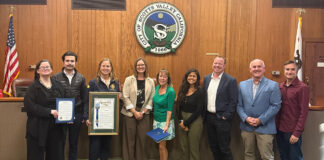
On November 19th, the County of Santa Cruz presented 69 businesses with a Green Business Certificate. 10 of those businesses are in our area, including Brunetti’s Interiors, the City of Scotts Valley, Faust Salon and Spa, San Lorenzo Water District, Santa Cruz County Bank, Scotts Valley Chamber of Commerce, Scotts Valley Water District, Suki’s Boho Boutique, Wild Roots Market, and Satellite Telework Network. I interviewed several of these businesses to understand how and why they use green practices.
The Terrace- Building in the Neighborhood You Live
If you’ve spent any time driving through Scotts Valley these past couple of months, you’ve probably noticed a few new developments around town. A notable housing development behind the Shell Station on the intersection of Mount Hermon Road and Scotts Valley Drive, the Terrace, plans on opening quickly after the new year. The Terrace has been under construction since last May and will ultimately be made up of 19 homes. Each will have 3 bedrooms and 2.5 bathrooms, in blocks of five.
Daytime and overnight traffic control on Highway 9 in Felton continues...
A project to construct sidewalks, curb ramps, driveways and retaining walls on Highway 9 between Graham Hill Road and the San Lorenzo Valley schools...