
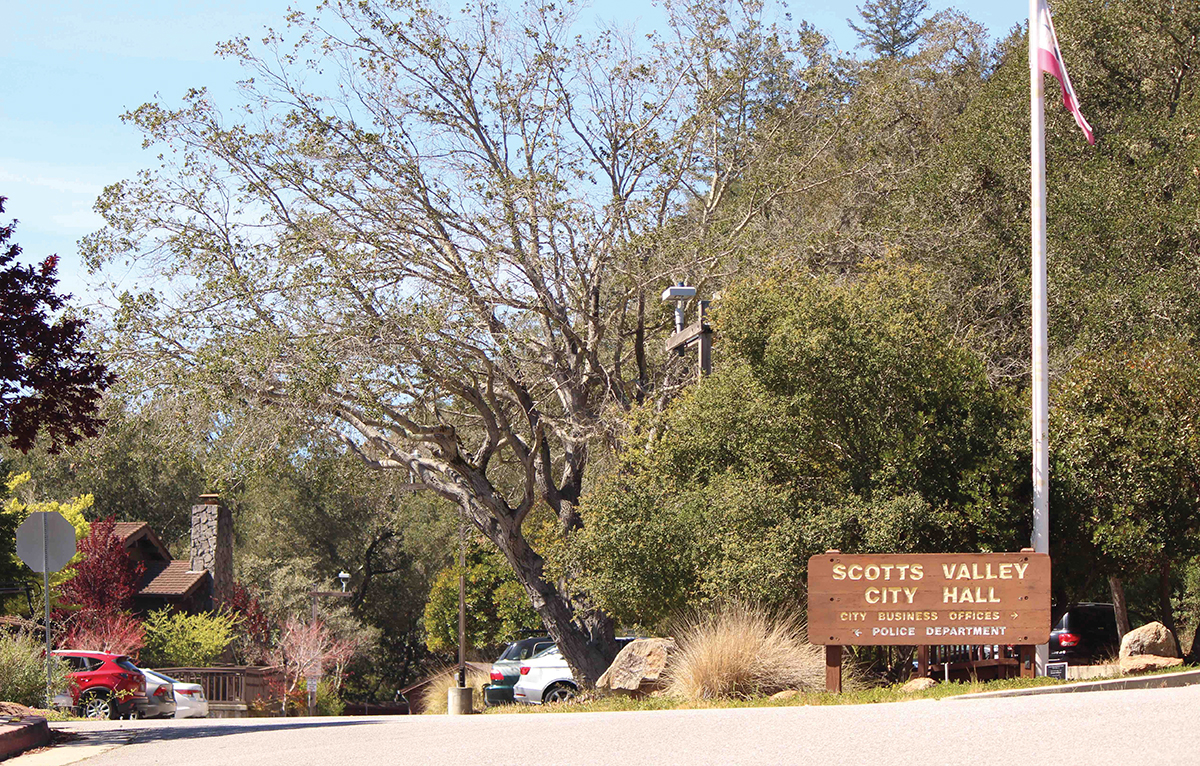
Scotts Valley City Council’s Jan. 21 meeting made some serious progress on the Town Center development—essentially doing some of the housekeeping items needed to move the project forward.
Before getting started, Councilmember Greg Wimp recused himself since the Town Center development could indirectly affect his sandwich shop.
City Manager Kirsten Powell explained that the next step in moving forward with the mixed-use—including affordable housing—project was to declare certain parcels “surplus lands.”
“This is a very exciting milestone,” she said. “For decades the City Council has pursued a dream of building the Town Center on vacant land formerly occupied by the Skypark airport.”
But the City is required to comply with the Surplus Lands Act, Powell explained.
“Because the parcels are not required for public use, but rather intended to be developed in accordance with the Town Center Specific Plan, Government Code Section 54220…requires the Council to declare those parcels ‘surplus,’” she said.
Because the parcels in question add up to around 18 acres, the City must require the buyer to build at least 300 housing units—with at least 25% restricted to people of lower income levels (for a minimum of 55 years for rental and 45 years for sale).
Powell said she worked closely with the Department of Housing and Community Development to ensure the paperwork was in line with their expectations (and therefore can be approved as rapidly as possible).
The declaration was approved unanimously.
This opens the door to the next phase—selecting a developer.
Work Around Town
In other business discussed at the meeting, Scotts Valley’s Public Works department has decided to go with Anderson Pacific to repair the sinkhole near Carl’s Jr. that led the City to declare a State of Emergency earlier this month.
In addition, the contractor that’s working on the Grace Way Well, along Scotts Valley Drive, hit a sewer main just prior to the Council meeting. The City also has begun working on a wastewater rate study and a wastewater plant master plan.
City Manager Mali LaGoe said at the previous week’s 3CE board meeting, they approved a power purchase agreement with the landfill in Monterey—to buy power generated by gasses that emerge from the site.
“It’s a really neat renewable energy project—and the first government-to-government partnership that 3CE has to procure power,” she said. “It’s a small project, but we’re hoping that it will grow over time, as both entities learn more about the potential of this power source—to reuse that gas that comes off of the landfill. It’s a really cool project to hear about.”
Human Trafficking Prevention
Last week’s meeting started off with a meaningful proclamation about Human Trafficking Prevention Month.
“Human trafficking affects communities as a whole and can impact everyone and anyone—regardless of their age, gender, background or circumstance,” said Mayor Donna Lind, reading from the document. “Human trafficking is connected to many other forms of violence and exploitation.”
Loreal Weitzel, the co-founder and executive director of Scotts Valley-based Arukah Project, stepped up to the podium next.
“Thank you truly for this proclamation,” she said. “While this moment may appear brief on an agenda, for survivors it carries extraordinary weight. It tells them that their stories matter, that their community sees them and that they’re not alone.”
Human trafficking doesn’t always resemble the movies, she continued.
“Here in Santa Cruz County, it often looks like online grooming, manipulation disguised as love, coercion and control happening quietly, but sometimes in plain sight,” she said, noting a recent Civil Grand Jury Report made it clear this is a real problem in Santa Cruz County. “It is here. And how communities respond can change the course of someone’s life.”
She explained that because Arukah Project is a “survivor-led” organization, they can truly understand what victims are going through.
Drawing Winners
Also at the meeting, the City used wheelofnames.com to pick the winners of the Shop Local Win Local campaign.
Shannon Youmans earned first place in the draw, Suzy Hunt took second and the third-place winner was Erica Thomas.
City Manager LaGoe gave Administrative Analyst Jordan Taylor his props.
“This was an effort really driven by Administrative Analyst Jordan Taylor,” she said. “This year the program was really, really easy. We basically invited anyone who shopped at Scotts Valley businesses during the holiday season—from basically Black Friday through the end of December—to provide us a copy of their receipt.”
The bill had to be over $10. Scotts Valley received more than 120 entries.
The need for the promotion was clear, that LaGoe had previously noted that business had been slower at least at certain parts of this recent holiday season at brick-and-mortar shops than in the past.
Taylor said it was cool to see how many different types of businesses that local residents frequented as part of Shop Local Win Local.
“If this sounds cool to you, keep your eyes (open), because we’ll be doing more things to support local businesses, and encouraging folks to shop local—and thinking of fun and creative ways to incentivize that,” Taylor said. “Thanks to everyone who participated.”
Mid-year budget report
Stephanie Hill, the Scotts Valley’s administrative services director, also presented the mid-year budget report to the Council.
She had some good news to share: Scotts Valley is doing $1.1 million better than predicted (with revenues coming in $1 million stronger; expenses about on-target), thanks to the Sandraya Heights residential development proceeding more quickly than anticipated, hounding for federal disaster aid reimbursements finally paying off, and a cell tower lessee catching up on payments.
Franchise fees and investment earnings also contributed to the positive picture.
The data shows another pretty hopeful trend, too.
The Fiscal Year 2024-25 actuals showed Scotts Valley brought in $19,996,686—but spent $20,958,787.
The adopted budget for this year had Scotts Valley collecting $20,073,376 and spending $21,512,768.
But now, Scotts Valley has crossed the threshold—with an amended budget of $22,858,376 in revenue against $22,012,768 in expenditures.
Of course, given much of the bump-up this time was from one-time payments. So, it’s unclear if Scotts Valley can maintain this trajectory without additional municipal creativity.
The Council had delayed approving the money for the Community Grant Program, so it agreed to work toward releasing the funds (i.e. local nonprofits will now start sharpening their pencils and considering what they’ll say on the application form).