
The steady hum of cars along Highway 9 is a constant in the San Lorenzo Valley. It carries commuters, connects small mountain towns and draws visitors into Boulder Creek’s redwood-lined downtown. But for many residents, that same roadway has long felt as dangerous as it is essential.
Now, a new wave of momentum—and funding—is bringing hope for change.
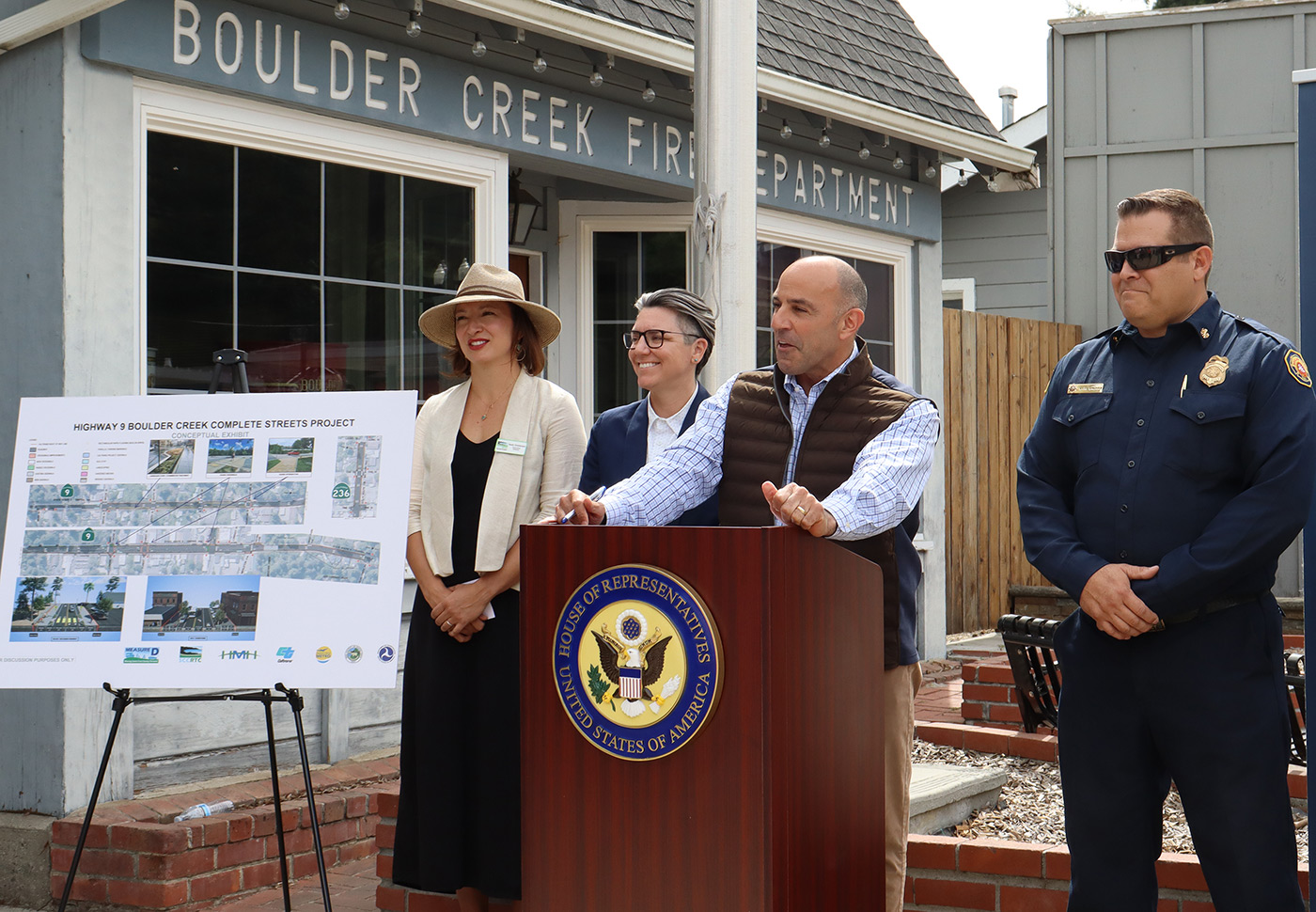
Local, state and federal leaders recently gathered in Boulder Creek to announce an $850,000 federal investment toward the long-anticipated Boulder Creek Complete Streets Project. The funds, secured by Congressman Jimmy Panetta, support a plan that aims to transform a one-mile stretch of Highway 9 into a safer, more accessible corridor for drivers, pedestrians and cyclists alike.
“This is about the safety of our community, our children and our way of life,” said Fifth District Supervisor Monica Martinez. “Right now, people don’t feel safe walking to a park or letting their kids bike to school. That’s something we need to change.”
Though Boulder Creek has a population of just over 5,000, the Highway 9 corridor sees about 17,000 trips each day. It functions as a commuter route to Silicon Valley, a tourism gateway and even an evacuation route during emergencies. But that heavy use comes at a cost.
Data shows that the stretch of Highway 9 through downtown Boulder Creek has more than double the collision and injury rates—and nearly three times the fatality rate—compared to similar roadways across California.
For locals, those numbers reflect lived experience.
“Have you ever tried to cross Highway 9 on a busy day?” asked Tess Fitzgerald, president of the Boulder Creek Business Association. “If so, you know why we’re here.”
The Complete Streets Project is designed to address those concerns without losing what makes Boulder Creek unique. Proposed improvements include expanded sidewalks, bike lanes, better lighting, clearer signage, curb extensions and upgraded transit stops—all aimed at slowing traffic and improving safety.
“We’re not trying to become somewhere else,” Fitzgerald said. “We just want a safer, more accessible downtown where people feel comfortable spending time.”
The project carries an estimated price tag of nearly $11 million and remains several years away from construction. Still, officials say the newly secured funding marks a critical step forward.
“This demonstrates commitment,” said Sarah Christensen, executive director of the Santa Cruz County Regional Transportation Commission (RTC), which is overseeing the project. “When you receive funding like this, it helps move the project closer to construction and makes it more competitive for future grants.”
The RTC has already committed local Measure D funds to support the effort. Passed by voters in 2016, Measure D allocated funding for transportation improvements across Santa Cruz County, including Highway 9.
For Matt Machado, Santa Cruz County’s deputy executive officer and public works director, the project highlights how central transportation is to everyday life.
“It’s something we all rely on, whether we think about it or not,” Machado said. “Our economy depends on it, our families depend on it, and safety has to be at the forefront.”
That focus on safety resonates deeply with first responders. According to Boulder Creek Fire Chief Mark Bingham, these improvements could reduce serious accidents and emergency calls.
“This is going to make our community safer,” Bingham said. “These improvements will mean fewer injuries and fewer emergencies.”
Bingham noted that he had met with the RTC back when the initial project featured a tree-lined downtown and a road with raised medians down the center, but he stood firm against those ideas.
“Having endured the CZU Fire, I knew that adding more vegetation along the highway would only create a more catastrophic situation should another fire come through town,” he said. As for the medians, “Our engines need to be able to do tight u-turns and drive down the middle of the highway. The RTC’s idea for raised medians would mean less safety in town, so I was glad that they heard my concerns, not just as fire chief, but also as fire marshal for Boulder Creek.”
Beyond safety, the project is also seen as an investment in Boulder Creek’s future. A more walkable downtown could encourage residents and visitors alike to spend more time and money locally.
“When people feel safe being downtown, our businesses grow,” Fitzgerald said, “and the whole community benefits.”
The effort has been decades in the making, with planning discussions dating back to the 1960s. For many, the announcement signals that long-standing ideas are finally becoming reality.
“It’s meaningful to see real progress,” Fitzgerald added.
Significant work remains, including securing the remaining funding and completing environmental and design phases. Construction could begin as early as 2028 or 2029, with completion possibly by 2030 or 2031.
Still, leaders say the collaboration behind the project is what gives them confidence.
“What matters most is the partnership,” Martinez said. “When people come together like this, we can make real progress.”
Congressman Panetta agreed. “This will jumpstart more funding coming in at the state, county and local levels, and that’s really the impetus for me to then submit a community-funded project, which we get through the appropriations process. That was done based on my knowledge of Boulder Creek, and the people of Boulder Creek. My office put in for over a million dollars toward this project; unfortunately, the appropriations committee cut it back to $850,000, but it’s still the power of the first efforts being felt right here in the community. It’s going to be a long process, and we’ll continue to work with the RTC and Supervisor Martinez. If there are opportunities for more federal funding, we’ll fight for that,” promised Panetta.
To learn more about the project, visit tinyurl.com/tu4wpxtw.