
Fridays, as a small child, was a very important day of the week; this was the day Uncle would reach deep into his pocket of his bib overalls, sorting out a dime and a nickel, my week’s allowance for helping Aunt in her kitchen.
Friday at five o’clock I would wait on our front porch for Uncle to come home from his long day’s work at the cedar sawmill, which our property adjoined. I would follow Uncle into the laundry room at the back of our house, where he would take off his hat and long leather apron and hang them on a hook, wash his hands in the sink and walk through the kitchen into the large living room, where his rocking chair sat by the wood heater. From October through winter, that wood heater was always burning to keep the downstairs rooms warm in our old boarding house. Aberdeen, Wash., was near the Pacific Ocean, and when the sun began to sink in the west, as the saying goes, we became as cold as a well-digger’s a—!
I would climb onto Uncle’s lap, where he was always ready to read the comic section to me; Little Orphan Annie and Donald Duck and his nephews were my favorites, so much so, I would beg Uncle to reread them.
Saturdays for this person as a small child were my favorite day of the week. Saturday meant going to the food market with Uncle and Aunt so many years ago. I loved the market, where two oak barrels without their lids stood alongside the meat counter, one holding hundreds of dill pickles in their brine, and the other, sauerkraut still fermenting in its saltwater juices.
While Aunt was shopping, I was next door at the drugstore, where a large magazine rack held dozens of magazines and newspapers. I would take my time, trying to decide which comic book I would choose to spend 10 cents of my weekly allowance of 15 cents on. Once the decision was made, I would move onto the candy section, where I would spend my five cents on five sticks of black licorice. Finished, and out of money, I would wander down the street to Kress Five and Dime store, where I would walk along each counter, smelling the perfumes and then over to the sewing material section, looking at all of the colors of the skeins of embroidery threads that were available.
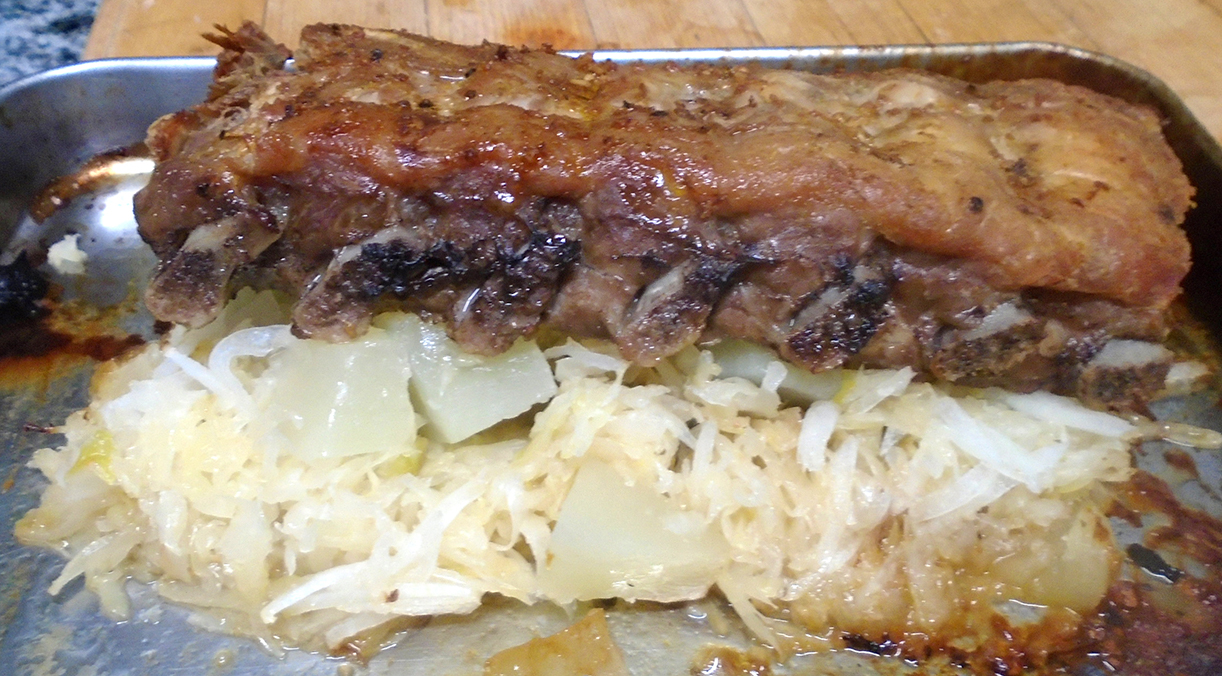
During those cold winter months, smells coming from Aunt’s kitchen were often from pork chops or pork spareribs that Aunt had purchased during her Saturday shopping trip. Along with the pork, Aunt added sauerkraut, onions and potatoes to the pan.
The sauerkraut that Aunt added to her pork dishes was not from the downtown market, but from the 10-gallon crockpot that was placed on a stool next to the water heater in our bathroom and the cabbage came from Uncle’s garden.
Sauerkraut — thought to have originated in the German-speaking lands of central Europe, actually originated during the construction of the Great Wall of China by laborers who consumed the fermented cabbage preserved in rice wine.
In my travels, I have eaten sauerkraut in Bavaria along with sausages and beer. In France, chefs served sauerkraut along with sausages and potatoes. Poland, Kapusta (sauerkraut) is the filling for pierogi dumplings.
In the United States, German immigrants brought sauerkraut to Pennsylvania to Wisconsin — topping sausages (today’s hotdogs) and adding to Reuben sandwiches, which I love the most.
Korea has its own recipe for sauerkraut, Kimchi, which has its own particular spices added.
I always find it interesting that only German restaurant menus contain this delicious vegetable. Cabbage, green beans, asparagus and spinach never appear on any of my favorite restaurant’s dinner plates. Personally, I am so tired of steamed broccoli, zucchini and carrot sticks appearing on my dinner plate in a restaurant. Bland and boring.
For the last 40 years, I have prepared my aunt’s recipe for pork spareribs and sauerkraut dinners, which always includes a side of applesauce; homemade, of course!
When purchasing spareribs for the recipe below, make sure the butcher removes the thin layer of skin (referred to as silver skin) from the bone side of the rib’s length. This silver skin prevents spices from penetrating that side of the ribs and becomes tough once cooked.
I often remember the Tyrolean Inn here in Ben Lomond that served some of the best German-style foods I have ever eaten. Gone are the schnitzels, sauerbraten, spätzle and beer that I have enjoyed there in the past. I am thankful that I have Aunt’s recipe to share with you, dear readers.
Don’t forget a side of Mustard and Horseradish!
Pork Spareribs, Potatoes and Sauerkraut
Preheat Oven 350 deg.
• One 3-4 lb. slab of Spareribs with silver skin removed.
Rub meat with mixture of:
• 5 cloves of smashed/diced garlic.
• 1 tsp. onion salt
• 2 tsp. smoked paprika
• 2 tsp. Italian Seasoning
• 1/8 tsp. cayenne pepper
• 1 Tbsp. olive oil
Wrap ribs in double layer of aluminum foil and seal tightly. Place on baking sheet and roast 1 hour.
While ribs are baking, dice and fry 4 bacon slices until crisp.
With bacon in pan add:
• 1/2 cup thinly sliced onion
• 3 cups sauerkraut, lightly drained
• Cut 1 cup of potatoes into one-inch cubes.
• 1/4 cup of water.
Cover pan and cook for 8 minutes.
Unseal and add potato and sauerkraut mixture to foil packet and place ribs on top of potato mixture.
Leave foil packet open and return to oven.
Bake until ribs are nicely browned.
Serve with Applesauce, homemade preferred.
Colly Gruczelak, a Ben Lomond resident, loves people and loves to cook. Contact her at cz****@*****st.net.