

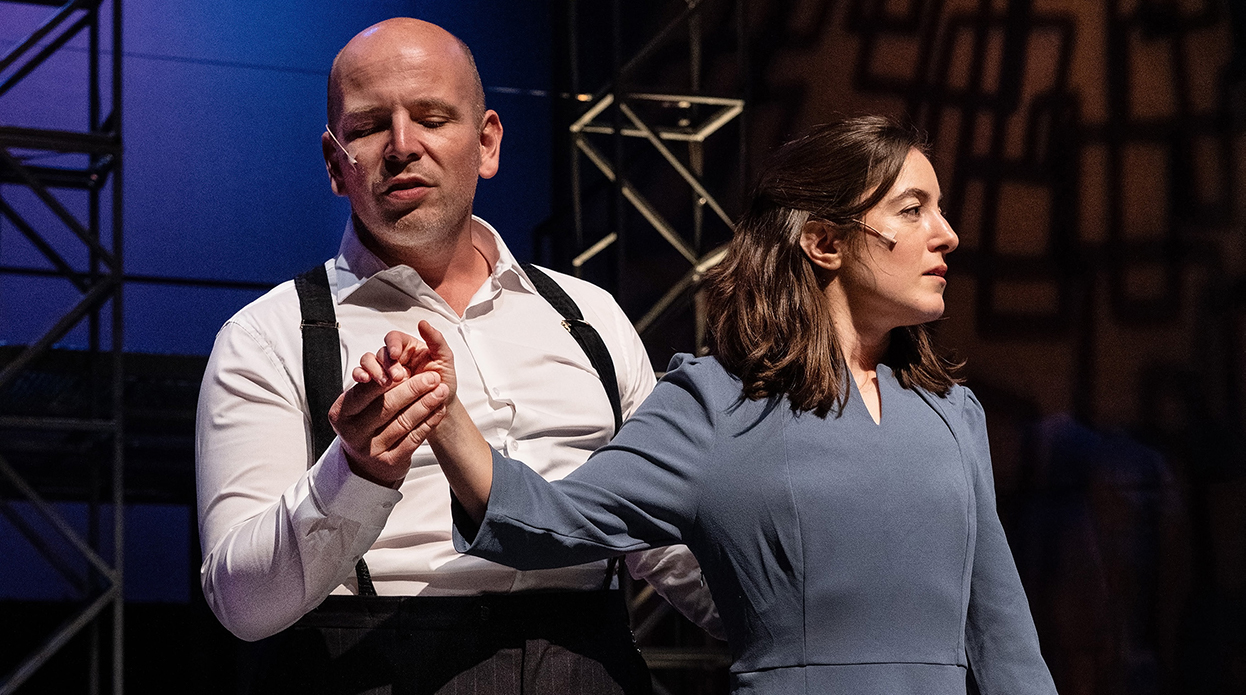
A woman stands in the middle of a world that never seems to stop moving.
Around her, people work, talk, walk and carry on with the routines of everyday life. Machines churn. Voices fill the air. The world is busy, indifferent and relentlessly in motion. But at the center of it all, a young woman is struggling to breathe.
That tension drives “Machinal” (mah-SHEE-nahl), Sophie Treadwell’s landmark expressionist play now running at Cabrillo College under the direction of Robin Aronson, who has returned to the work for a third time. The production, featuring Sarah Mitchler as the central character, explores the experience of a woman constrained by the expectations of the world around her—and her yearning for something beyond the life prescribed for her.
For Aronson, the opportunity to direct the play again was an easy choice.
“We considered some other options, and then, just inside of myself, was, like, just once more, once more for this brilliant, gorgeous play,” Aronson said.
Having first directed “Machinal” at the University of Oregon in the 1990s and again at West Valley College seven years ago, Aronson wanted to bring a personal interpretation of the work to Santa Cruz audiences. Part of its appeal is the unusual combination of characters who feel both universal and deeply human.
That contrast is central to a play whose title, drawn from the French word for mechanical, evokes a world operating according to an impersonal rhythm.
Written by journalist and playwright Sophie Treadwell, “Machinal” emerged from a story that had captivated the nation. Treadwell attended the sensational 1927 murder trial of Ruth Snyder, a Queens housewife accused of conspiring with her lover to kill her husband. But rather than reproduce the lurid headlines and public fascination surrounding the case, Treadwell turned inward, seeking to understand the woman behind the crime.
Within four months of Snyder’s execution, Treadwell had written a first draft of the play, which premiered on Broadway in September 1928. The urgency of that response reflected more than the immediacy of a notorious criminal case. Through an expressionist lens, Treadwell transformed Snyder’s story into a broader examination of how a woman could be pushed to desperation by a society that left little room for independence or self-determination.
Her central character, identified simply as Young Woman, became an everywoman figure rather than a portrait of Snyder alone. The play’s nine episodes trace the pressures of work, marriage, motherhood and the pursuit of happiness in a world that seems to operate like a machine. Rather than simply retelling a crime, however, Treadwell created a work that examines the pressures surrounding a woman’s life and the consequences of a society that leaves her little room to choose her own path.
Its expressionist style, fragmented scenes and rhythmic dialogue distinguish it from more conventional dramas, making the production both a challenge and an opportunity for those bringing it to life.
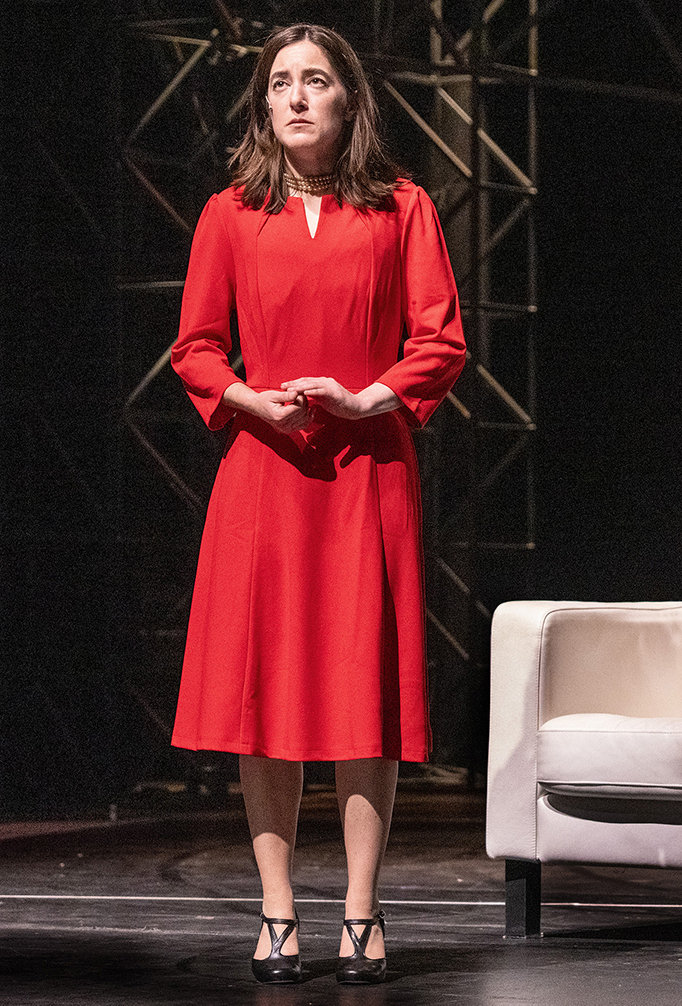
Mitchler said the script initially felt awkward when she read it before auditioning. But at the first table read, something shifted.
“The script is quite bare in what it gives you,” she said. “But at the same time, the words are so expressive, they elicit such emotion when you say them aloud.”
The language, she said, invites actors to make strong choices.
“There’s so many different ways you can say, ‘Oh, ma,’” said Mitchler, referring to a line that is often repeated by Mitchler’s character. “I almost like that she says so little, because you can put so much in the variations she adopts. Every single word becomes dynamite,” she added, alluding to the Shakespearean quality of the script.
Playing Young Woman required Mitchler to inhabit someone who is often isolated even when surrounded by people. The character struggles with anxiety and the physical sensation of not being able to breathe, Mitchler said. Although she is questioning her circumstances from the beginning, she does not experience a complete breakdown until the end.
“She is struggling in daily life, in a way that others seemingly aren’t,” Mitchler said.
Mitchler sees the character’s isolation as one of the play’s most heartbreaking elements, particularly in its relationship to the next generation. Her final thoughts about her daughter, she said, reflect a plea for a different life and a different experience. That plea resonates beyond the story’s historical setting.
Aronson said the cast recognized the play’s relevance during rehearsals, particularly in its examination of the ways women continue to be controlled and constrained.
“There’s still the idea that women are controlled and constricted by the world around them,” said Aronson, pointing to restrictions that can be societal, cultural or personal.
Mitchler, too, sees the production as an invitation to recognize the experiences that can make it difficult for women to speak up or exercise their own choices.
“I don’t think we’re gonna hit you over the head with it because it is exploring what it was like 100 years ago,” she said. “But people recognize those feelings. People recognize the inability to say no, to speak up for yourself.”
Aronson’s staging underscores that sense of entrapment through a striking visual world. Although “Machinal” can be performed with relatively simple, realistic settings, Aronson chose to surround its intimate scenes with a larger theatrical structure designed by set designer Kipp Epperson. Elements that appear in the original script as sounds or offstage activity become physical presences onstage. Construction workers, doctors and other figures move through the production, while performers create a mechanical world through choreography and movement. The result places Young Woman inside a busy environment that rarely acknowledges her distress.
For Aronson, those additions expand the audience’s understanding of the world pressing in on her. It is a creative choice that also reflects the director’s investment in the educational side of the production. As a professor directing a mix of seasoned and student actors, Aronson welcomed a script with enough roles to involve a large cast and give students opportunities to develop their craft.
The spare language and stark staging leave little room for distraction when Young Woman is alone. Mitchler’s performance becomes the audience’s anchor, even as the activity surrounding her continues. It is a portrait of a woman searching for something she cannot quite name—until she briefly tastes a life that feels different. Mitchler returned to the character’s final words as a way of understanding that longing: “I was always seeking something.”
The line captures the tragedy at the heart of “Machinal,” but also its enduring humanity. Beneath the mechanical rhythms of work, marriage and social obligation is a person trying to find a life that belongs to her. For Aronson, that desire is ultimately what makes the play worth revisiting.
“The moral, the lesson,” Aronson said, is that “oppression still happens, and it still affects people, and there’s always that desire to be free.”
“Machinal” runs at Cabrillo College’s Crocker Theater through Nov. 15. For more information or to purchase tickets, visit cabrillovapa.universitytickets.com.