




Gluten: Intolerance or Celiac?

Approximately 30 to 40 percent of our population eat gluten free food for reasons unrelated to gluten intolerance or sensitivity. There's no evidence that gluten, a protein found in wheat and some other cereal grains, causes digestive problems in people who don't have a gluten related disorder, such as celiac disease or non-celiac gluten sensitivity.
An Auspicious Debut (Part 3)

Famous for fox-hunting and polo, the Meadow Brook country club had also earned a place in golf history. According to one account, the “old and exciting Scotch game” caught on in America in 1892, after a young lady brought a full set of clubs with her on a visit from the Old World and began teaching her hosts. “Golf promises to become a formidable rival to lawn tennis and other outdoor sports in this country,” predicted the New York Sun. From the earnestness with which the Long Islanders have taken hold of the game there is ground for belief that it will spread rapidly to other portions of the United States.” The members of the Meadow Brook club laid out a course on their grounds in the spring of 1895. One of the club’s first events was a competition between the women members for a silver powder puff, “beautifully engraved.” That fall, the club was the scene of the first national women’s championship tournament. When not practicing polo, Marion Hollins spent time on the Meadow Brook links. Team captain Louise Hitchcock, who had been a spectator at the inaugural tournament, was also an expert golfer. The nine-hole course was “of an undulating character,” featuring a wide variety of hazards—quite unlike the one Marion had practically grown up on. Stretching over two miles of countryside, it favored golfers with strong tee shots—her specialty. The Westbrook Country Club, also established in 1895, had been carved out of the private estates of a Wall Street banker and one of the Vanderbilt heirs. “The ground is perfectly level,” noted one sports columnist, “and devoid of natural features favorable to golf, but it is nevertheless very picturesque.” Marion’s parents, Harry B. and Evelina Knapp Hollins, were among the founding members of the Westbrook club. When Thomas Hitchcock offered a silver chafing dish as a prize for the best score posted in October, Mr. Hollins finished a close second. Golf was the favorite sport of the Hollins youngsters—four boys and Marion, the baby of the family. The oldest son, Harry Jr., showed off considerable skills as a teenager. Competing in an open competition in 1896, he bested a field of older rivals. Among the losers was his father, “who protested that thereafter his identity was gone and he must resign himself to be known as the father of a golf player.” Harry Jr. attended Harvard, where he continued to excel as a member of the college team. Younger brothers Gerald Vanderbilt and McKim were also considered top-notch amateurs. The fourth brother, however, preferred tennis. In May 1912, Marion decided to try her hand at tournament play. One of the most important events on the women’s golf calendar was the championship of the Women’s Metropolitan Golf Association, featuring several national champions. Moving ahead in an elimination competition at a New Jersey country club, the “forceful young player” bested several veteran players. In a hard-fought semi-final match, her clutch performance impressed observers. “When Miss Hollins found it was do or die, she developed great steadiness and made the contest a seesaw affair till the home green was reached. There she won by a carefulness and poise of play that greatly pleased her friends.” Facing a local favorite in the finals, it became apparent the “Miss Hollins was not playing her usual brilliant game.” Although her drives carried well, she had trouble sinking putts. It turned out that she was suffering from a peculiar accident—a blade of grass had lodged in her throat, preventing her from sleeping. Playing despite intense pain, “she showed flashes of her usual form, but she was beaten.” In spite of the outcome it had been a successful debut and the sporting press predicted “a bright golf future for her.”(To be continued.)
Sports Shorts

Both San Lorenzo Valley and Scotts Valley high schools played a number of preseason games.
The valleys’ most valuable

Scotts Valley’s Aldin Barrett and San Lorenzo Valley’s Kyle Todd were named Santa Cruz Coast Athletic League Most-Valuable Players this week.
The Dammed River: Mr. Pierce’s Neighborhood
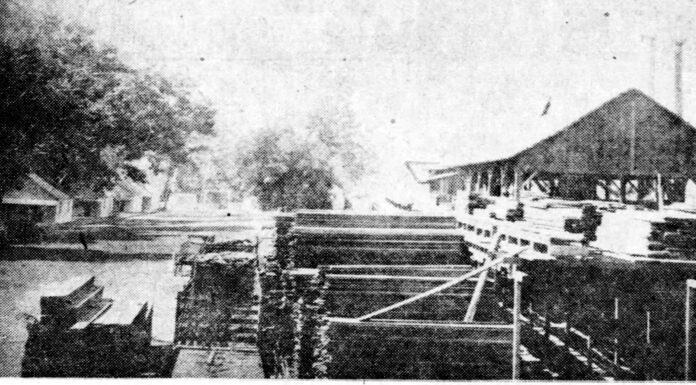
1887. From the porch of “Hillside,” his aptly-named summer estate, timber baron James P. Pierce could literally oversee his domain. Away to the north were redwood-covered slopes, awaiting harvest. In the foreground, just across the San Lorenzo River, was the site of his new Pacific Mill, a railroad station, and what one visitor referred to as “quite a little village.”Pierce had made a fortune washing gold off hillsides with powerful hoses. After investing in the San Lorenzo flume and railroad in the 1870s, he purchased 2000 acres of uncut timberland in the heart of the valley. The original Pacific Mill at the mouth of Love Creek worked up lumber along the river to what is now Glen Arbor, relying on the flume for transportation. When the Felton and Pescadero railroad was completed in 1885, Pierce quickly recognized a different opportunity for profit and relocated his operation across the river.The new Pacific Mill was thoroughly up-to-date, containing machinery for the manufacture of all sorts of finished lumber. In addition to the usual circular saws, it housed a band saw, the first in the area, allowing finer processing. “Every part of the log is worked up and nothing wasted,” the Pacific Rural Press reported in 1887, “Even all the spare sawdust is sold to a San Jose brewery at $25 a carload. More could be sold there, but it is used at the mill to fire the boilers.”The water of San Lorenzo was also utilized, brought into a large mill pond on the low ground where the river looped around the site. “A dam is being built, noted a reporter, “and a pond constructed where the logs will be floated for more convenient selection before sawing. A railway is in process of construction…on both sides of the pond, where the logs will be unloaded directly into the water.” Although there had been sawmills in the area since pioneer days, much of the old-growth forest on the difficult local slopes had survived. Pierce’s lumber-cutting campaign relied on transportation. The railroad depot became a hub that linked the new bridges to the surrounding region and the spur tracks that led to the sawmill. In cooperation with the Ben Lomond Wine Company, located on Empire Grade, what is now called Alba Road was cleared and graded, providing access to the trees on the side of Ben Lomond Mountain. On the other side of the river, the timber in the upper reaches of Love Creek would be taken out by his company’s own train, running three miles up its corporate track. To support the mill and its workforce, Pierce and his superintendant, Thomas L. Bell, provided a variety of other buildings on the river bank across from the mill — a general store, warehouses for grain and hay, a boarding house for the men, cottages for families and a large amount of stabling. “The finest of water” was brought in from Marshall’s creek, through over 1500 feet of pipe.More than the usual amenities were provided. The company store offered both telegraph and telephone service and a Wells Fargo Express office. “The Post Office, “observed the Santa Cruz Surf, “will doubtless be established in the same place.” This prediction proved true in April 1887. Federal authorities, however, rejected the name “Pacific Mills,” so the appellation “Ben Lomond” was borrowed from the nearby mountain and winery.While train and mill whistles signaled a rush of industrial activity, Pierce planned a different sort of future for Ben Lomond as a place “of residence and resort.” His ideas were up-scale — this was not to be a “stump town” like Boulder Creek. His own residence, “Hillside,” which featured a large reception room and a “baronial” fireplace, was designed to convince other affluent businessmen to move to the neighborhood.In the fall of 1887, the land around the mill and railroad depot was subdivided into town lots. The Sentinel approved, noting that “Mr. Pierce, by these sales, is proving himself a benefactor to the neighborhood – new people are moving to that locality, houses are being erected, homes established, grounds cultivated, orchards set out and a population of sterling, thrifty citizens secured.”To further the goal of attracting high-class summer visitors, Pierce and Bell planned a luxurious resort. “One of the prettiest locations in the village,” advertised the Surf, “has been reserved for a hotel site. It is a roomy, wooded knoll, sloping downward to the San Lorenzo on one side, quite convenient to its railroad station and commanding picturesque mountain and valley views.” The site would also feature “an abundance of water.”(To Be Continued)Randall C. Brown is a local historian and is a member of the San Lorenzo Valley Board of Directors

MIXED RESULTS FOR MOUNTAINS SURF TEAM

On Sunday, February 23 the Santa Cruz Mountains Surf Team, made up of surfers from San Lorenzo Valley High, Scotts Valley High, and a few other inland schools, faced off against heavily favored Santa Cruz High at their home break, Steamer Lane. While the SC Mountains team lost overall in the team-vs-team rounds (44-60), several individual team members surfed well enough to advance to quarterfinals, semifinals and, in some cases, finals in individual competition later in the day.
It’s the law: A day at the beach

There are good reasons why people want to live in Santa Cruz County — a moderate climate, clean air, mountains, redwoods and, of course, the beach.
There’s an ornamental grass for every garden

One of the most dramatic sites in a garden is an ornamental grass backlit by late afternoon sun. They seem to come alive as their tawny flowers spikes glow and sway in the breeze. Their gentle movement and soft whispering sounds can bring your garden to life as few other plants do.

Three candidates vie for two Scotts Valley council seats
Mike Zeller, the director of programming and project delivery for the Transportation Agency for Monterey County, is the relative newcomer on the Scotts Valley...