




SV sewer rates up 15 % in Sept.

Scotts Valley homes and businesses connected to city sewer lines face bigger waste treatment fees for three years beginning Sept.1, totaling 52 percent over three years.

An Auspicious Debut (Part 3)

Famous for fox-hunting and polo, the Meadow Brook country club had also earned a place in golf history. According to one account, the “old and exciting Scotch game” caught on in America in 1892, after a young lady brought a full set of clubs with her on a visit from the Old World and began teaching her hosts. “Golf promises to become a formidable rival to lawn tennis and other outdoor sports in this country,” predicted the New York Sun. From the earnestness with which the Long Islanders have taken hold of the game there is ground for belief that it will spread rapidly to other portions of the United States.” The members of the Meadow Brook club laid out a course on their grounds in the spring of 1895. One of the club’s first events was a competition between the women members for a silver powder puff, “beautifully engraved.” That fall, the club was the scene of the first national women’s championship tournament. When not practicing polo, Marion Hollins spent time on the Meadow Brook links. Team captain Louise Hitchcock, who had been a spectator at the inaugural tournament, was also an expert golfer. The nine-hole course was “of an undulating character,” featuring a wide variety of hazards—quite unlike the one Marion had practically grown up on. Stretching over two miles of countryside, it favored golfers with strong tee shots—her specialty. The Westbrook Country Club, also established in 1895, had been carved out of the private estates of a Wall Street banker and one of the Vanderbilt heirs. “The ground is perfectly level,” noted one sports columnist, “and devoid of natural features favorable to golf, but it is nevertheless very picturesque.” Marion’s parents, Harry B. and Evelina Knapp Hollins, were among the founding members of the Westbrook club. When Thomas Hitchcock offered a silver chafing dish as a prize for the best score posted in October, Mr. Hollins finished a close second. Golf was the favorite sport of the Hollins youngsters—four boys and Marion, the baby of the family. The oldest son, Harry Jr., showed off considerable skills as a teenager. Competing in an open competition in 1896, he bested a field of older rivals. Among the losers was his father, “who protested that thereafter his identity was gone and he must resign himself to be known as the father of a golf player.” Harry Jr. attended Harvard, where he continued to excel as a member of the college team. Younger brothers Gerald Vanderbilt and McKim were also considered top-notch amateurs. The fourth brother, however, preferred tennis. In May 1912, Marion decided to try her hand at tournament play. One of the most important events on the women’s golf calendar was the championship of the Women’s Metropolitan Golf Association, featuring several national champions. Moving ahead in an elimination competition at a New Jersey country club, the “forceful young player” bested several veteran players. In a hard-fought semi-final match, her clutch performance impressed observers. “When Miss Hollins found it was do or die, she developed great steadiness and made the contest a seesaw affair till the home green was reached. There she won by a carefulness and poise of play that greatly pleased her friends.” Facing a local favorite in the finals, it became apparent the “Miss Hollins was not playing her usual brilliant game.” Although her drives carried well, she had trouble sinking putts. It turned out that she was suffering from a peculiar accident—a blade of grass had lodged in her throat, preventing her from sleeping. Playing despite intense pain, “she showed flashes of her usual form, but she was beaten.” In spite of the outcome it had been a successful debut and the sporting press predicted “a bright golf future for her.”(To be continued.)
Do you live on a private road?
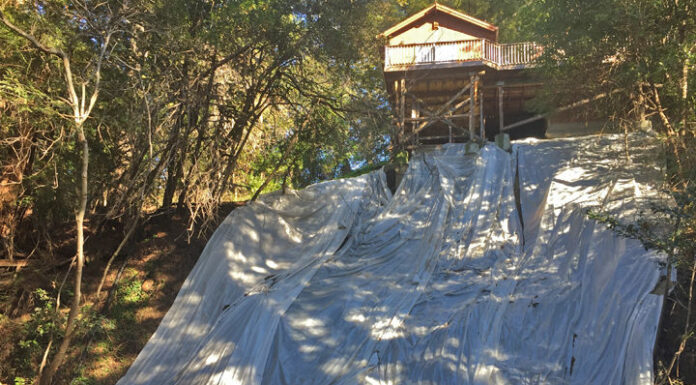
When late January storms triggered the muddy hillside below Peter Meyer’s Cadillac Drive home to tumble across the road below he sprang into action.But since Cadillac Drive is a private road there was no summoning help from the City of Scotts Valley or Santa Cruz County. Instead, Meyer called a contractor himself and paid more than $100,000 out of his pocket for emergency repairs to open the road.“It was the right thing to do,” said Meyer, who specializes in executive and management development. “If I didn’t do it how could I talk to my neighbors?”What happened on Cadillac Drive has been occurring across Santa Cruz this winter as private road dwellers are forced to pick up the tab for repairing their streets — problems ranging from potholes to massive mudslides.If roads are privately maintained and open for public access, with no barriers or gates allowed, then property are responsible for all repairs. Municipal codes allow emergency vehicles and utility workers to use the roads and make repairs to utility lines, and water and sewer lines..In the case of Scotts Valley, the area is a hodgepodge of public and private ways that existed when the city was incorporated in 1966. Some streets –, and Scotts Valley Drive, Grace Way and Blossom Way – are a hybrid of public and private domains.“Scotts Valley inherited what the county already had,” said Scott Hamby, city public works director, adding that the ratio is about half and half – and is not likely to change anytime soon.“The city would love to take over all the roads, but it’s a financial issue.”So do all private road dwellers dig deep into their pockets when disaster strikes?Not really. But some people who weren’t paying attention when they closed escrow were surprised when the rains wreaked havoc on their street and they realized they were private.“I wonder how many people just don’t understand,” said Ann Nixon, whose husband has lived on Lower Southwood Drive, a private road, for 41 years. Her husband fills the street’s potholes so their seven neighbors can get smoothly in and out — but he’s a bit over 70 and can’t toil forever.The best-case scenario for private road owners is creating a road maintenance association to build up a reserve fund for repairs. On Cadillac Drive the property owners have an association, but that is not designated for emergency repairs.Meyer’s friends have established a GoFundMe page to solicit donations for his generosity. In the last month, 30 people have donated $2,805 of the $130,000 goal.Meyer’s cottage behind his house and overlooking the mudslide has been red-tagged, although he is still able to live in his house.Meanwhile, Fifth District Supervisor Bruce McPherson has been attempting to secure federal aid for private roads and properties. Under President Trump’s emergency funding FEMA money is not available. “Our fragile mountain roads have taken a beating,” he said in a recent editorial.McPherson’s office recently helped residents on Hopkins Gulch, Wilderfield Road, Huckleberry Island and Heartwood Hill roads in the San Lorenzo Valley get emergency funding.“We’re encouraging all private road owners to work with the Resource Conservation District to maintain their roads,” said Robin Musitelli, senior analyst for McPherson, referring to the grant-funded conservation district that can assist with road association formation.Private road owners wishing to form an association can go to www.rdcsantacruz.org and request a consultation and on-site visit from the Rural Road Erosion Assistance Program.An association can also form a County Service Area (CSA) to pay for local government services on their property-tax bills. CSA’s are unique because residents determine their benefit-assessment rate, which can range from $10 to $1,000 per parcel.Applications for this avenue can be obtained from the Local Agency Formation Commission at the county building at 701 Ocean St. in Santa Cruz.
Summer vibes return to Skypark with Food Truck Fridays and Taco Tuesdays

You know that summer is almost here when the convoy of food trucks comes back to Skypark. Starting Friday, April 26, Food Trucks a Go Go presents Food Truck Fridays, the area’s largest food truck festival with new owners Josh and Teresa Swart.
Head to...
The Mountain Gardener: Save Water — Save Trees
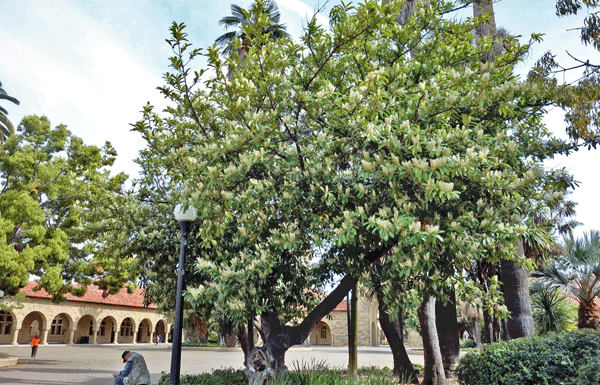
I had to do it. I couldn’t resist. Even though I’d vowed not to get any new plants until fall planting season when I saw the one gallon Pride of Madeira just begging for a new home I succumbed to my impulse. I rationalized this plant was on my wish list and will be drought tolerant so I wasn’t being totally irresponsible.I’ve always wanted an echium fastuosum on my hillside. I admire those huge spires of purple-blue flowers whenever I see them in other gardens. These are tough plants getting by with no summer water once established and the flower spikes are bee magnets. I covered it with a layer of shade cloth for a few days because it was so hot when I planted it. This will help it establish more quickly while the roots take hold in the soil.In your own garden it’s wise to establish a drought to-do list. I’m talking about what plants get your precious water and what to let go.Entering another dry year, many of our ornamental and fruit trees are dying because of lack of water. Others might have been surviving on natural rainfall. Whatever the case is in your garden, don’t let your trees die.Nature has already killed an estimated 12 million trees in our California forests since the drought began four years ago. Most of these have fallen victim to bark beetles that attack trees weakened by drought.In our own neighborhoods, trees are a long-lived asset. A tree is not something that can be easily replaced. It’s OK to appropriately water trees. Dying trees can be a safety hazard and removing a dead tree is expensive.It takes years to grow a tree to mature size. Save and use shower and cooking water to help them out. Maybe it’s time to install a simple laundry-to-landscape system to water your landscape trees. Or set up a separate drip or soaker hose for your trees and give them a good deep drink at least once or twice a month. Remember that the tree’s feeder roots are not at the base of the trunk but out at the drip line and a little beyond.A rule of thumb for determining when to irrigate is when 50-percent of the water has been depleted from the soil in the plants’ root zone. This rule allows a buffer of water in the soil in case the weather suddenly turns hot and windy. The rule also applies to trees, shrubs and perennials.Sandy soils hold less water than clay soils and must be irrigated more frequently. A common misconception is that it takes more water to grow plants in sandy soil than in clay soil. Actually the total amount required for the whole year is the same for both soil types. The amount of sunlight, wind, temperature and humidity control how much water a plants needs - the soil is only the reservoir.To check the water content in the soil: dig 8 to 16-inches down into the soil with a trowel, shovel, or soil tube, feel the soil. When you get to the level of about 50-percent available water, look for these conditions: course soil appears almost dry and forms a ball that does not hold its shape, loamy soil forms a dark ball that is somewhat moldable and can form a weak ribbon when squeezed between your fingersclay soil forms a good, dark ball and makes a ribbon an inch or so long and is slightly sticky.If you are planning to plant some new trees this fall, be sure they are drought tolerant natives or low water use non-natives. There are many nice specimens to choose from. Remember not to skimp on the mulch.It’s important to maintain our existing tree canopy and plants for the future. Even in times of drought, no especiallyin drought, planting and stewardship of trees is critical. Not just for their future but for ours as well.- Jan Nelson, a landscape designer and California certified nursery professional, will answer questions about gardening in the Santa Cruz Mountains. E-mail her atjanis001@aol.com, or visitwww.jannelsonlandscapedesign.comto view past columns and pictures.
Nature Friendly: Thinking like a watershed at Loch Lomond

As she peered down through the water at the south end of Loch Lomond, inveterate kayaker Alecia Morgan spied something big, round and white. Maneuvering her boat around, she slipped her paddle down three feet into the sandy shoreline and picked up a Canada goose egg,

Scotts Valley graduate receives Teamsters scholarship
Violeta Dauksa of Scotts Valley has been named a recipient of a 2026 scholarship from the International Brotherhood of Teamsters Scholarship Fund.
Dauksa is a...