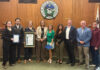


When Heather Lewis Sebring asks older adults about moving, she does not begin with boxes, floor plans or what needs to go.
She starts with a much better question: “What would you like your life to be full of in the next 10 years?”
More travel? Friends? Grandchildren? Community? Less time maintaining a house that once fit your life perfectly but now seems to have developed a full-time job description of its own?
That question is at the heart of Sebring’s new business, Heart Centered Transitions. As a senior relocation specialist, she helps older adults and their families manage the many decisions involved in a later-life move.
Professional movers handle packing and transportation. Sebring manages the transition around the move: planning, downsizing, choosing what will fit in the new home, working with professionals, setting up the new space, and helping clear what is left behind.
From Corporate Planning to Heart-Centered Planning
Heather opened her business in January 2026. Earlier in her career, she worked in senior roles at the Schwab Center for Investment Research. After leaving them, one lesson remained: “… good planning creates better choices.”
With her natural desire to help others, she found herself helping aging and ill family members through emotional and practical transitions. She saw firsthand what families often discover too late: a later-life move isn’t as simple as hiring movers on Saturday and ordering pizza when the truck leaves.
A later-life move is far more complicated than it appears. “It’s hundreds of decisions and tasks,” she says.
After years of supporting her family, raising her daughter, and putting her skills to work in different ways, Sebring reached another transition in her life. “It was finally time for me.” She asked what she knew well, what she cared deeply about, and how those skills could serve others.
Heart Centered Transitions was the answer.
Keeping Choice in the Conversation
Sebring often talks about control, not because she wants to control the move, but because she wants the person moving to maintain control. In other words, it’s about planning before the crisis.
“My client is always the person that’s moving,” she says, even when adult children are the ones who call. That distinction matters.
Sebring told a story about meeting a woman who had moved into a senior living community. A special event was coming up, but the woman was not attending. During her move, her son had discarded her dressy clothes, never considering that her new life might include dressy occasions.
It is a small story with a big message. We can become so focused on what someone is leaving that we forget to ask what they are moving toward.
“The move isn’t the goal,” Sebring says. “The life you want on the other side of the decision is the goal.”
That is also why she encourages families to talk before a fall, illness or other crisis forces a decision.
“The best conversations are had when no one’s being forced to make a decision in a crisis.”
Planning is not the same as deciding, she mentions. It means exploring possibilities while you still have time to choose among them.
Start With the Linen Closet
Then there is the stuff. Most of us know we have too much of it. We prefer not to discuss exactly how much.
Sebring’s approach to downsizing is refreshingly simple: “Don’t think about what you want to get rid of. Think about what you want to keep.”
She even suggests putting those Amazon boxes to work. When one arrives, fill it with things you no longer need and move them along. Start somewhere low-stakes, perhaps the linen closet, rather than beginning with Grandma’s China and convening a family summit before lunch.
“Downsizing isn’t about deciding what you’re willing to lose,” she says. “It’s about deciding what matters enough to keep.”
A Different Question About Aging
Sebring believes our homes should support the lives we want to live, not simply represent the lives we have already lived.
Deferred maintenance, difficult stairs, isolation, or rooms that are rarely used do not automatically mean it is time to move. They may be signs that it is time to explore.
“The question isn’t simply, ‘Can I stay in my house?’” she says. “A better question is, ‘Will this house continue to support the life I want?’”
That may lead someone to modify a current home, move closer to family, choose a smaller home or explore a senior living community. Sebring is less interested in prescribing the answer than making sure people have enough time and information to make their own.
She is also taking that message into the community through educational programs on planning ahead, downsizing and thinking realistically, but positively, about later life.
And that is what makes her approach feel different. This is not a conversation about getting old and giving things up. It is a conversation about designing what comes next.
Sebring talks about older adults finding new relationships, rediscovering passions, building businesses, painting, playing golf and finally having more time for themselves.
Life is still happening.
So perhaps Heather Sebring’s question is one worth borrowing, whether you are 60, 70, 80 or someone who owns a closet you are afraid to open:
What do you want your life to be full of over the next 10 years?
The answer may tell you much more than where you should live. It may remind you why planning the next chapter matters in the first place. Want to reach out to Heather? Email he*****@**********************ns.com for later-life move planning, relocation, downsizing and relocation.
Janet Janssen, a Speaker and Communications Coach, Chamber of Commerce Member in San Lorenzo Valley, Scotts Valley and Santa Cruz, Board Member of Leadership Santa Cruz County, is hosting a free webinar on Sept. 30. Ask for details: ja***@**********en.com.