
In honor and celebration of Wildfire Preparedness Week (May 3-9), Shawn Gardner and Walt Mullins, co-founders of FireRoofs, want locals to know that a new tool is available to help homeowners combat the very real threat of wildfires.
Gardner managed parks and irrigation systems for the City of Saratoga, while Mullins ran a licensed general contracting firm building custom homes across the Santa Cruz Mountains. Both understood water delivery, construction and the terrain. Neither could find a wildfire defense system they would trust on their own properties, so they created one using their combined years of experience.
Thanks to them, anyone in Scotts Valley, Boulder Creek or Ben Lomond can go to fireroofs.com/hydroiq and get real answers about their fire zone, defensible space requirements and California’s new wildfire insurance laws. There is no account required and no sales pitch to residents; it’s just a tool that helps homeowners in high fire risk areas like ours.
Five years after the devastating CZU Lightning Complex fires tore through the Santa Cruz Mountains, the scars remain, especially in the lives of homeowners who continue to grapple with the realities of living in a high-risk wildfire zone.
“The CZU fire, even though it was five years ago, still affects all the homeowners,” Gardner explained. “We started this company because we realized putting water on the outside of houses helps even more to protect them and increase survivability.”
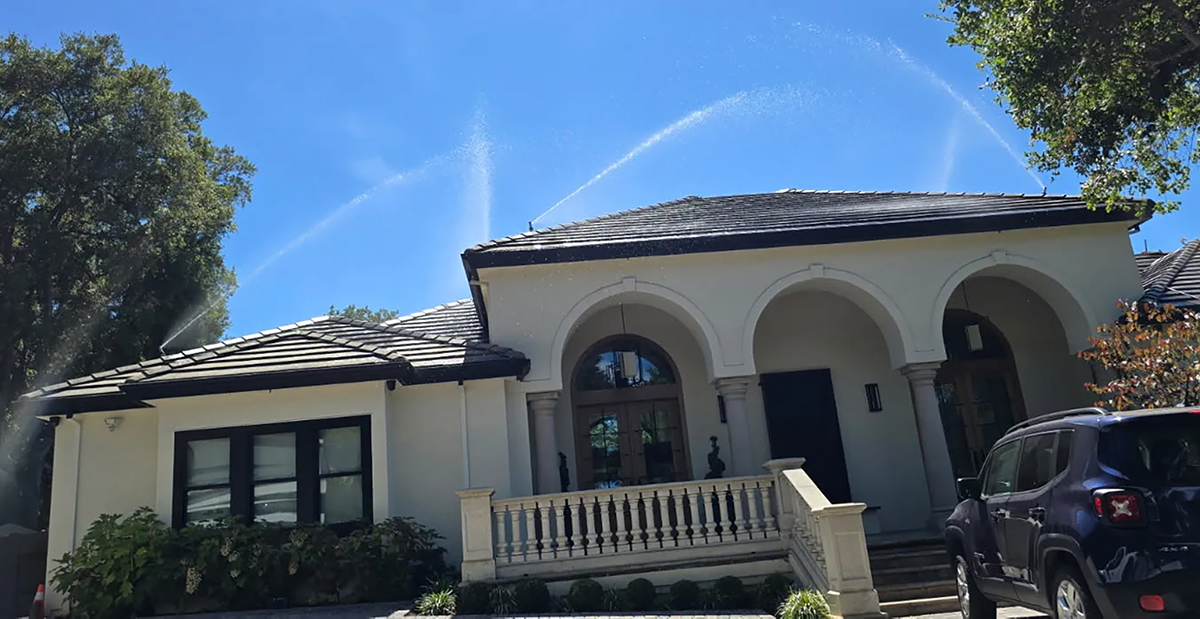
That realization led to the development of a wildfire defense system designed to actively protect homes by keeping vulnerable areas wet during a fire event. But as the company began working with clients, another problem quickly surfaced.
“Homeowners were having a lot of pain points trying to find the right information,” Gardner said. “They were bouncing from state websites to agency websites to county fire to the Office of Emergency Services, and the information was all over.”
Out of that frustration came a second innovation: a digital tool designed to simplify wildfire preparedness. The company built an AI-powered assistant called Hydro IQ, which compiles extensive data from across agencies into one accessible platform.
“We built a wildfire assistant that uses AI with a really good knowledge database, all the way down to the county and jurisdictional level across nine Bay Area counties,” Gardner said. “You can go in and ask, ‘I live in Ben Lomond. What’s a good evacuation plan?’ or ‘How do I protect my house?’ And it gets into everything.”
The goal, Gardner emphasized, is not to sell a product, but to empower homeowners.
“It’s not sales-focused. It’s information-focused for everyone in the Bay Area and the state of California.”
That focus on education comes at a critical time, as many homeowners struggle with skyrocketing insurance costs and limited coverage options under the California FAIR Plan.
“Insurance is a really big pain point,” Gardner acknowledged. “But the more you do to prepare your home—think defensible space, home hardening, Class A roofs, vents—you can actually start applying to standard carriers again.”
He points out that wildfire mitigation isn’t one single solution, but a combination of efforts.
“There are 12 categories of fire mitigation for homeowners,” Gardner said. “Insurance companies want to see that your home is safe and protected before they’re going to insure you.”
The company’s exterior sprinkler system is just one piece of that puzzle.
“We don’t say exterior sprinklers are the savior,” Gardner explained. “We compare it to vehicle safety. You need good tires, brakes and seatbelts before airbags. Our product is like the airbags.”
The idea for the system came to light after watching news coverage of homes that survived fires by using pool water and makeshift sprinklers.
“It clicked for us that we could do something good here,” Gardner said. “We come from an irrigation and public works background, and we understood the risk. Fires are getting more intense every few years.”
That technical background, combined with personal connections to those impacted by wildfire, shaped the company’s mission.
“I had family in Boulder Creek, and the CZU Fire came within a few houses of them,” Gardner said. “So yes, it hit home.”
His experience in fire fuel reduction projects also reinforced a key insight: wildfire risk is hyper-local.
“The risk is local, and the intensity and severity of fires are increasing,” Gardner said. “We wanted to combine our knowledge and produce something that’s going to help save people’s homes.”
A critical factor in that effort is addressing how homes ignite in the first place.
“Ninety percent of homes that burn during wildfires is because of timber ignition,” Gardner explained. “If we keep that zone around the house—gutters, Zone 0, even nearby hillsides—wet, that’s going to be key in saving homes.”
Still, the company has intentionally kept a low profile while refining its technology.
“We’ve kind of been off the radar,” Gardner said. “We focused on developing the technology, getting real systems out there, and making sure we have happy customers.”
Now, with installations across the Bay Area and a growing knowledge platform, they’re beginning to expand their outreach through community meetings and Firewise events. Interestingly, most of their installations have not been in the Santa Cruz Mountains.
“To be honest, we’ve completed almost zero installations locally,” Gardner said. “The main reason is the FAIR Plan cap of $3 million; homes valued above that have a serious gap.”
In higher-value areas like Los Altos, Saratoga and Woodside, that gap has driven demand for added protection.
“The insurance market has really built the business,” Gardner lamented. “Insurance is not there for people anymore, and it’s much harder to get and afford.”
Despite the challenges, his message remains focused on preparedness rather than fear.
“We help homeowners protect their homes from wildfire with pure wildfire defense,” Gardner said. “But at the same time, we want everybody to have the knowledge at their hands.”
That includes simple but critical steps: clearing defensible space, creating evacuation plans and preparing emergency supplies.
“Fire season is not just a season anymore,” Gardner said, “and there’s no better time to prepare your family and your home than right now.”
For Gardner, success isn’t measured solely in installations or downloads, but in resilience.
“Even if somebody doesn’t want our product, we want them to have the knowledge,” Gardner said. “Because being prepared is what’s going to make the difference.”
For information on the company and to access the HydroIQ platform to learn about protecting homes from wildfires, visit fireroofs.com.