
“…fava beans and a nice Chianti.” —Hannibal Lecter
After seeing the movie, “The Silence of the Lambs,” for many years I had a difficult time separating Anthony Hopkins from his role of (flesh-eating) Hannibal Lecter and cooking fava beans, which I really love to eat.
I was first introduced to these beans by my dear departed friend, Portuguese born Mary Mello Whalen. Our homes were both on Watsonville’s country road, Green Valley, and being close, both as friends and our homes, we spent many hours together cooking and eating.
The Whalen girls and my children were close in age, and our spouses were schoolmates in the 1930s. We were more like relatives than just friends.
Mary was a gardener; I was not. Mary was more liken to a “chef,” while I was just learning to cook. The nuns in my convent boardinghouse gave me kitchen chores where I was given the duties of a sous chef, plus the washer of lots and lots of pots and pans. I was taught bread baking and how to thinly peel carrots and potatoes. While Mary, during our years as friends, taught me how to prepare and cook veggies and meats that until then, were foreign to me.
Portuguese Sopas was Mary’s specialty. The Portuguese would bury and cook large chunks of heavily spiced beef in a covered pot over an underground fire overnight and the next day would add hunks of French bread into the broth, which made for the best soup one could eat. Stuffing animal intestines with spicy ground pork, called linguiça sausage, starchy elephant-ear corms and a fava bean stew were more of Mary’s dishes; the last being my favorite. Oh, there were wonderful Christmas cookies, the recipes of which I have shared here on Plain Talk, however the fava beans are still my favorite today. Mary always made extra for me to take home. Bless you, dear Mary.
Grown in Mexico and the Mediterranean countries due to their mild temperature, fava beans made their first appearance in the U.S. in the late 1800s, having been brought in by Italian and Portuguese immigrants. Once their high nutrient contents were discovered, favas today are grown mainly as a cover crop; ground up and mixed into the existing soil to enrich the farmer’s acreage.
With such a short harvest time, markets, usually farmers markets, can be found selling these little-known beans. In my lifetime, I have never eaten fava beans at a restaurant, nor at any of my friend’s or relative’s homes.
This July I remembered it was the end of the crop time for favas and I frantically began my hopeful search for favas. Sorry, I was told by Shopper’s Corner; we had some, but no more. None this year, said Safeway and Nob Hill, and one market had never heard of this bean. But I got lucky. Wild Roots in Felton said they would try and try they did. I was able to buy seven pounds of favas at $3.69 a pound, that resulted in five full cups of beans once shelled.
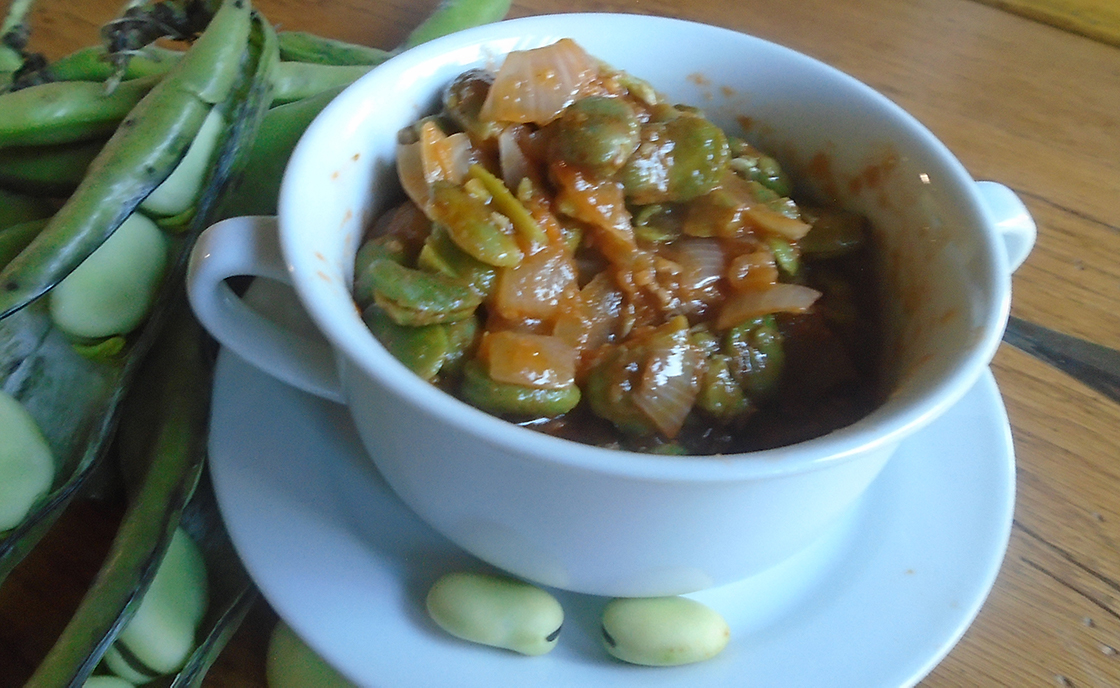
Favas, when mature, are anywhere up to 8 inches in length with each pod producing an average of six 1-inch beans. White in color, favas are a bean in a shell, which is encased in a “pea-like” pod.
Preparing the fava for cooking begins with pinching off the end of the pod and tearing the string attached to the end along the length of the pod. Once revealed, take the beans from the pod and drop them into a pot of boiling water (called blanching). After one minute, drain the water from the pot and run cold water over the beans to prevent further cooking. Drain the beans…and now comes the fun part. The edible part is inside the tough shell.
Pinch off the end of the bean, breaking its skin and squeeze the other end of the bean, which will force the edible bean to pop out. It’s work, but worth the effort.
If you are going to sauté the beans in butter and garlic along with diced scallions, you only need to cook them for two to three minutes. Diced tomatoes can be added as well as bacon bits. So delicious.
The fava bean can be added to salads, stews and soups. Needed cooking time is just a few minutes, much like fresh green peas.
Sprinkle the favas, which have had a dash of olive oil and garlic salt over a charcuterie tray. You will have many questions as to “what are these.”
I enjoy replacing the chick peas with the fava beans in hummus.
Crème de Fava (Portugal)
• 3 cups fresh fava beans
• 2 cups Better than Bullion Chicken flavor
• 2 Tbsp. olive oil
• 1 tsp. garlic salt
• 1 tsp. onion salt
• 1 tsp. pepper
• Salt is optional
In a soup pot bring ingredients to a boil and then turn down to a simmer. Cook for 25-30 minutes.
Pour ingredients into a blender and blend until smooth and creamy.
Top with croutons and serve.
Delicious and full of healthy nutrients.
Sopa De Habas (Fava Bean Soup/Mexico)
• 3 cups of shelled fava beans
• 1/2 Tbsp. vegetable oil
• 1/3 cup diced onion
• 1 minced garlic clove
• 2 cups diced tomatoes
• 3 cups cooked fresh fava beans
• 2 cups diced chicken breast or thighs
• 1 cup warm water
• 2 Tbsp. Better than Bullion Chicken flavor
• 1 small (3oz.) can diced green chilies
• 1 tsp. cumin
• 1 Tbsp. diced cilantro
Sauté onions and garlic in vegetable oil until onions are softened.
Add tomatoes and cook 5 minutes.
Add rest of ingredients and simmer 1/2 hour.
So delicious!
Colly Gruczelak, a Ben Lomond resident, loves people and loves to cook. Contact her at cz****@*****st.net.